

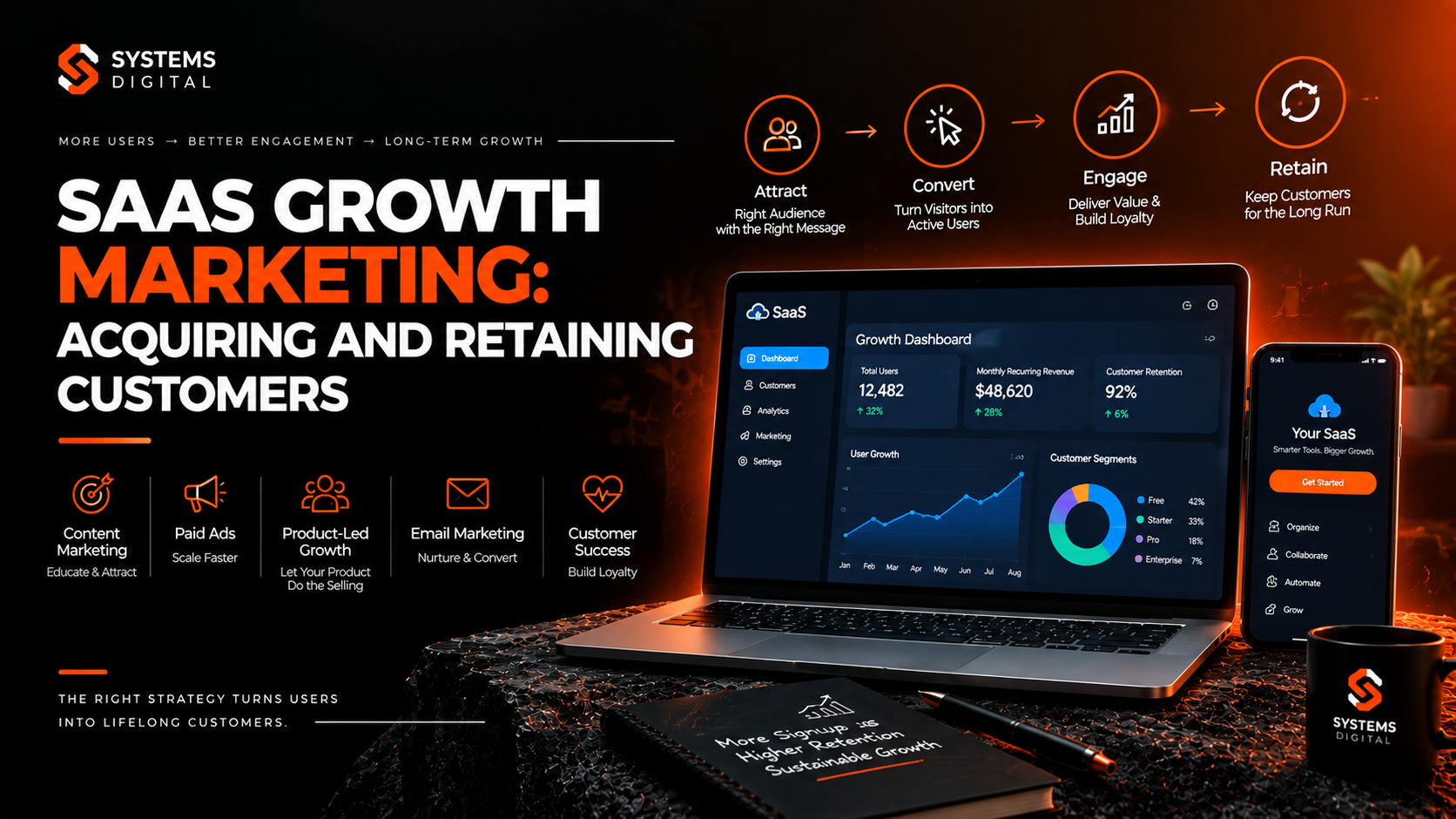
Winning a SaaS customer is only half the job. Keeping them is where the real money is made.
Software as a service runs on recurring revenue. A customer who signs up today but cancels in three months rarely repays what it cost to acquire them. That is why SaaS growth marketing treats acquisition and retention as one connected system, not two separate departments.
In this guide, you’ll learn what SaaS growth marketing is, which acquisition and retention strategies work, and which metrics to track. You’ll also see real-world examples, the skills and tools involved, and the career opportunities in Australia’s growing software market.
Whether you’re a founder, a marketer, or someone planning a move into SaaS, you’ll leave with a clear, practical roadmap.
What Is SaaS Growth Marketing?
SaaS growth marketing is a data-driven approach to attracting, converting, and retaining subscription customers across the entire customer lifecycle. Instead of focusing only on lead generation, it optimises every stage: awareness, signup, activation, retention, and expansion.
Traditional marketing often ends when a lead becomes a customer. In SaaS, that’s just the beginning. Revenue depends on customers staying, using the product, and eventually spending more.
How SaaS Growth Marketing Differs From Traditional Marketing
- Revenue model: SaaS earns recurring revenue (MRR and ARR), not one-off sales.
- Success metric: Lifetime value and retention matter more than single conversions.
- Testing culture: Growth teams run constant experiments on pages, emails, and onboarding flows.
- Product involvement: The product itself is a marketing channel through free trials, freemium plans, and in-app prompts.
- Time horizon: Payback is measured in months, not days.
The Core Idea: The SaaS Growth Model
A useful SaaS growth model has four stages:
- Acquire: Attract qualified prospects through content, ads, referrals, and partnerships.
- Activate: Help new users experience the product’s core value quickly.
- Retain: Keep users engaged so they renew month after month.
- Expand: Grow revenue from existing customers through upgrades, add-ons, and referrals.
Many teams over-invest in stage one and neglect the rest. The best SaaS growth strategies balance all four.
Why SaaS Growth Marketing Matters
Subscription businesses grow or shrink based on one equation: new revenue minus lost revenue. If churn is high, even strong acquisition can’t keep the business growing.
Retention Is Cheaper Than Acquisition
Acquiring a new customer usually costs far more than keeping an existing one. Bain & Company’s well-known research on retention economics has long argued that small improvements in retention can lead to disproportionately large profit gains.
Recurring Revenue Rewards Patience
A customer paying $100 a month is worth $1,200 a year. If they stay for three years, that’s $3,600. But if you paid $1,500 to acquire them and they leave after ten months, you’ve lost money.
Investors and Buyers Watch These Numbers
Investors examine SaaS metrics closely. Healthy retention, efficient acquisition, and net revenue retention above 100% all signal a business that compounds over time.
Competition Is Intense
The software market is crowded. When a competitor is one Google search away, your customer experience becomes a real differentiator. Strong SaaS customer retention is often your best defence.
SaaS Customer Acquisition: Strategies That Work
SaaS customer acquisition is the process of attracting and converting new subscribers profitably. The goal isn’t just more customers. It’s the right customers at a cost you can sustain.
1. Start With a Clear Ideal Customer Profile
Before spending on channels, define who you serve best. Build SaaS buyer personas from real data:
- Industry and company size
- Job titles and pain points
- Current tools they use
- Buying triggers and objections
A narrow, well-defined audience almost always converts better than a broad one.
2. Build a Content Marketing Engine
SaaS content marketing builds trust before a prospect ever speaks to sales. Effective formats include:
- Problem-solving blog posts and guides
- Comparison pages (“Tool A vs Tool B”)
- Use-case and industry pages
- Templates, calculators, and free tools
- Case studies with real results
Content works best when it matches search intent at each funnel stage.
3. Invest in SaaS SEO
SaaS SEO is one of the most cost-effective long-term channels. Focus on three layers:
- Bottom-of-funnel: “best [category] software,” alternatives, and pricing queries
- Middle-of-funnel: comparison and how-to content
- Top-of-funnel: educational topics that build authority
Also optimise for answer engines and AI overviews. Use clear headings, direct definitions, and concise answers to common questions.
4. Use Paid Advertising Wisely
SaaS paid advertising and SaaS PPC marketing can accelerate growth, but only with tight tracking. Common channels include:
- Google Ads: captures high-intent searches
- LinkedIn: strong for B2B targeting by job title and industry
- Retargeting: brings back visitors who didn’t sign up
Watch your SaaS customer acquisition cost by channel. Pause what doesn’t pay back.
5. Offer Free Trials, Freemium, or Demos
Letting people try before they buy reduces risk. Each model suits a different product:
| Model | Best For | Main Challenge |
|---|---|---|
| Free trial | Products with fast time-to-value | Trial users may not activate |
| Freemium | Products with viral or network effects | Converting free users to paid |
| Demo-led | Complex or high-priced software | Longer sales cycle |
Improving trial-to-paid conversion often delivers a faster return than increasing ad spend.
6. Optimise Landing Pages and Signup Flows
SaaS conversion rate optimization starts with removing friction. Test these elements:
- Headline clarity and value proposition
- Number of signup form fields
- Social proof near the call to action
- Page speed and mobile experience
- Pricing page transparency
Small changes, tested properly, can lift conversions meaningfully.
7. Use Referrals and Partnerships
Referral marketing works because trust transfers. Happy customers refer similar customers. Build a simple programme with a clear reward for both sides. Partnerships with complementary tools and integration marketplaces can also open new audiences.
8. Combine Inbound and Outbound
SaaS inbound marketing attracts prospects through content and SEO. SaaS outbound marketing, including targeted cold email and LinkedIn outreach, reaches accounts that fit your ideal profile. For B2B products, a mix usually outperforms either alone.
SaaS Customer Retention: Keeping Customers Long Term
SaaS customer retention means keeping subscribers active and paying over time. It depends on delivering value repeatedly, not just at signup.
1. Make Onboarding Exceptional
Onboarding is where retention is won or lost. Users who don’t reach an early “aha moment” often leave quietly. SaaS onboarding best practices include:
- Define the single action that signals real value (your activation event).
- Guide new users to that action within their first session.
- Use checklists, tooltips, and short product tours.
- Send a timed email sequence that reinforces key steps.
- Offer a human touchpoint for higher-value accounts.
Improving customer activation is often the highest-leverage retention move.
2. Use Lifecycle Marketing
SaaS lifecycle marketing sends the right message at the right stage:
- Welcome: set expectations and first steps
- Activation: nudge users toward core features
- Engagement: share tips, updates, and best practices
- Renewal: remind customers of results achieved
- Win-back: re-engage users who’ve gone quiet
Behaviour-triggered messages consistently beat generic newsletters.
3. Track Customer Health Scores
A customer health score combines signals such as login frequency, feature usage, support tickets, and billing history. It flags accounts at risk before they cancel, so your customer success team can step in early.
4. Build a Real Feedback Loop
Ask customers what’s working and what isn’t. Use:
- NPS or CSAT surveys at key moments
- Exit surveys when someone cancels
- Regular customer interviews
- Support conversations analysed for patterns
Then close the loop. Tell customers when you’ve acted on their feedback. It builds customer loyalty.
5. Reduce Involuntary Churn
Not all churn is a decision. Failed payments cause a surprising share of cancellations. Reduce it with:
- Automatic card updater services
- Smart payment retry logic
- Clear pre-expiry reminders
- Easy in-app billing updates
6. Grow Revenue From Existing Customers
Expansion revenue makes retention profitable. Effective tactics include:
- Upselling: moving customers to a higher plan as they grow
- Cross-selling: offering relevant add-ons
- Usage-based triggers: prompting upgrades when limits are approached
- Seat expansion: encouraging team-wide adoption
When expansion outweighs churn, net revenue retention rises above 100%. That means your business can grow even without new customers.
7. Create Community and Advocacy
Customers who feel part of something stay longer. Communities, user groups, webinars, and customer advisory boards deepen customer advocacy and generate authentic word-of-mouth.
The SaaS Growth Funnel and Customer Journey
A SaaS marketing funnel maps how strangers become loyal customers. Understanding each stage helps you allocate effort wisely.
| Stage | Goal | Example Tactics |
|---|---|---|
| Awareness | Get discovered | SEO, social, paid ads, PR |
| Consideration | Build trust | Case studies, comparisons, webinars |
| Conversion | Win the signup | Free trials, demos, strong CTAs |
| Activation | Deliver first value | Onboarding flows, checklists |
| Retention | Keep them engaged | Lifecycle emails, customer success |
| Expansion | Grow account value | Upsells, cross-sells, referrals |
Modern teams also talk about growth loops and a growth flywheel. In a loop, the output of one stage feeds the next. For example, happy customers refer new users, who become happy customers, and so on. Loops compound in a way that linear funnels don’t.
Key SaaS Growth Metrics to Track
You can’t improve what you don’t measure. These SaaS growth metrics and SaaS marketing KPIs matter most.
Acquisition Metrics
- Customer acquisition cost (CAC): total sales and marketing spend divided by new customers won
- Trial-to-paid conversion rate: the share of trial users who become paying customers
- Lead-to-customer rate: how efficiently leads turn into revenue
- CAC payback period: months needed to recover acquisition cost
Retention Metrics
- Churn rate: the percentage of customers lost in a period
- Retention rate: the percentage who stay
- Gross revenue retention (GRR): revenue kept, excluding expansion
- Net revenue retention (NRR): revenue kept including upgrades
Value Metrics
- Customer lifetime value (LTV): the total revenue expected from a customer
- LTV to CAC ratio: a common benchmark is around 3:1 or higher
- ARPU: average revenue per user
- MRR and ARR: monthly and annual recurring revenue
A Quick Worked Example
Imagine a SaaS tool with these numbers:
- Average monthly revenue per customer: $80
- Gross margin: 80%
- Monthly churn: 3%
- CAC: $600
Customer lifetime is about 33 months (1 ÷ 0.03). LTV is roughly $80 × 0.80 × 33 = about $2,100. The LTV to CAC ratio is 3.5:1, which is healthy. Payback takes about 9 months ($600 ÷ $64 monthly gross profit).
If churn rose to 5%, lifetime would fall to 20 months and LTV to about $1,280. That’s a ratio of roughly 2.1:1. This is why churn deserves as much attention as acquisition.
Use Cohort Analysis
Cohort analysis groups customers by signup month and tracks their behaviour over time. It shows whether retention is improving, and which acquisition channels bring the stickiest customers.
Key Skills, Tools, and Benefits
Skills SaaS Growth Marketers Need
- Analytical thinking and comfort with data
- SEO and content strategy
- Paid media and conversion optimisation
- Lifecycle and email marketing
- Experiment design and A/B testing
- Product understanding and customer empathy
- Clear communication across teams
Essential Tools
| Category | Purpose | Examples |
|---|---|---|
| Analytics | Track behaviour and funnels | Google Analytics 4, Mixpanel, Amplitude |
| CRM and automation | Manage leads and campaigns | HubSpot, Salesforce |
| Email and lifecycle | Automate messaging | Customer.io, Mailchimp, ActiveCampaign |
| SEO | Research and tracking | Ahrefs, Semrush, Google Search Console |
| Testing | Optimise pages | VWO, Optimizely |
| Customer success | Monitor health | Gainsight, ChurnZero |
| In-app messaging | Guide users | Intercom, Userpilot |
Benefits of a Growth-Focused Approach
- More predictable revenue
- Lower wasted ad spend
- Stronger customer relationships
- Faster learning through experiments
- Higher business valuation over time
AI in SaaS Growth Marketing
AI is changing how teams grow. Practical uses include:
- Predictive churn models: flagging at-risk accounts from usage patterns
- Personalisation: tailoring onboarding and messaging by segment
- Lead scoring: prioritising prospects most likely to convert
- Content support: speeding up research, outlines, and drafts
- AI-powered support: answering common questions instantly
AI works best as an assistant to human judgement, not a replacement. Strategy, brand voice, and customer empathy still need people.
SaaS Marketing Careers: Scope, Salary, and Demand in Australia
Australia’s technology sector continues to produce strong demand for marketers who understand subscription businesses.
Common Roles
- SaaS growth marketer
- Growth marketing manager
- Demand generation manager
- Lifecycle or retention marketing specialist
- SaaS SEO specialist
- Product marketing manager
- Customer marketing manager
- Head of growth
Typical Salary Ranges
Salaries vary by city, seniority, and company size. As a rough guide, and subject to change, Australian growth and SaaS marketing roles often fall within these bands:
- Junior or coordinator: roughly AUD 65,000 to 85,000
- Mid-level specialist: roughly AUD 85,000 to 120,000
- Senior or manager: roughly AUD 120,000 to 160,000
- Head of growth or director: often above AUD 160,000
Check current data from job boards and salary guides before making decisions.
Why Demand Is Strong
Australian startups and scale-ups in Sydney, Melbourne, Brisbane, Perth, and Adelaide are competing for global customers. Many need marketers who can build repeatable systems for SaaS customer acquisition and SaaS customer retention, not just run campaigns.
Why Choose System Digital
If you want structured, practical guidance, the training provider you choose matters. Here’s what to look for, and where Why choose System Digital fits in.
A strong programme should offer:
- Practical, project-based learning that mirrors real SaaS work
- Up-to-date curriculum covering SEO, AI, analytics, and automation
- Experienced trainers who understand current industry practice
- Career support that connects learning to job outcomes
- Flexible formats for students and working professionals
System Digital focuses on job-ready digital skills, so learners can apply frameworks to real campaigns rather than just memorise theory. Learners who want to go deeper can explore advanced services at System Digital.
How to Learn SaaS Growth Marketing
You can start today, whatever your budget.
Free Resources
- Google Skillshop and Analytics Academy: free analytics and ads training
- HubSpot Academy: free courses on inbound, content, and email
- Blogs and newsletters: Reforge, Lenny’s Newsletter, ProfitWell, and SaaS-focused publications
- YouTube and podcasts: case studies and founder interviews
- Your own project: launch a small site, test SEO, and track results
Paid Resources
- Structured courses and bootcamps: guided learning with feedback and projects
- Growth programmes: deeper training on experimentation and analytics
- Certifications: useful signals for employers
- Mentorship: faster progress through expert review
A Simple 90-Day Learning Plan
- Days 1–30: Learn SaaS fundamentals, metrics, and funnel thinking.
- Days 31–60: Practise SEO, content, email, and landing page testing.
- Days 61–90: Run a small experiment, document results, and build a portfolio piece.
Employers value evidence. A documented experiment beats a certificate alone.
Real-World Examples of SaaS Growth Marketing
Dropbox: Referral-Driven Growth
Dropbox is a classic example of a growth loop. Users earned extra storage for inviting friends, and the reward directly improved the product. Each new user could bring more, so acquisition compounded.
Slack: Product-Led Growth
Slack spread through teams. One group started using it, saw value, and invited colleagues. The product experience did much of the selling, which kept acquisition costs low relative to traditional enterprise sales.
Canva: Freemium and Community
Australia’s own Canva combined a generous free plan with templates, education, and a strong creator community. Free users experience real value, and many upgrade as their needs grow. It shows how freemium can work when the free tier delivers genuine results.
Atlassian: Bottom-Up Adoption
Atlassian, another Australian success story, is widely known for building adoption through self-serve products and word-of-mouth among teams. It demonstrates how a low-friction start can grow into large accounts over time.
Lessons You Can Apply
- Make the product part of the marketing.
- Reward behaviour that helps both parties.
- Reduce friction at signup and first use.
- Invest in community and education.
- Let customer success drive expansion.
Future Opportunities in Australia
The outlook for SaaS marketing careers and businesses is encouraging.
- A growing startup ecosystem: Australian software companies increasingly target global markets from day one.
- AI adoption: teams need marketers who can combine automation with strategy.
- Data and privacy focus: compliance with the Privacy Act and consent expectations makes ethical, transparent marketing a strength.
- Remote and hybrid work: Australian marketers can now work with international SaaS teams.
- Specialisation: roles in retention, product-led growth, and analytics are becoming more distinct and better paid.
Professionals who combine technical fluency with commercial thinking will be well placed.
Frequently Asked Questions
What is SaaS growth marketing?
SaaS growth marketing is a data-driven approach to acquiring, converting, and retaining subscription customers. It optimises the full customer lifecycle, from first visit to renewal and expansion, using experiments, analytics, and lifecycle campaigns.
How do SaaS companies acquire customers?
SaaS companies acquire customers through SEO, content marketing, paid ads, free trials, referrals, partnerships, and outbound outreach. The best channels depend on the product, price point, and audience. Most teams test several channels and double down on those with the best CAC and retention.
How do you reduce churn in SaaS?
Reduce SaaS churn by improving onboarding, tracking customer health scores, gathering feedback, and fixing failed payments. Proactive customer success and behaviour-based lifecycle emails also help. Focus first on the activation stage, where many cancellations begin.
What is a good LTV to CAC ratio for SaaS?
A common benchmark is an LTV to CAC ratio of 3:1 or higher, meaning a customer generates three times what it cost to acquire them. Ideal ratios vary by stage and business model. Also check that payback happens within a reasonable window, often under 12 to 18 months.
What is product-led growth?
Product-led growth is a strategy where the product itself drives acquisition, conversion, and expansion. Users try the software through a free plan or trial, experience value, and upgrade on their own. Sales and marketing support this journey instead of leading it.
What is a good retention rate for SaaS?
It depends on the customer segment. Enterprise SaaS often achieves lower churn than small-business products. Rather than chasing one universal number, benchmark against similar companies and aim for steady improvement, with net revenue retention above 100% as a strong goal.
Conclusion: Grow by Keeping as Well as Winning
Sustainable SaaS growth depends on two things working together. You need a reliable engine for SaaS customer acquisition, and you need a strong system for SaaS customer retention. Neglect either and growth stalls.
Start with a clear customer profile, build content and SEO that earn trust, and make onboarding a priority. Track CAC, LTV, churn, and net revenue retention, and use experiments to improve steadily.
If you’re ready to build these skills or scale your own SaaS business, take the next step. Book a seat at Advance Services offered by System Digital and turn these strategies into real, measurable results.