


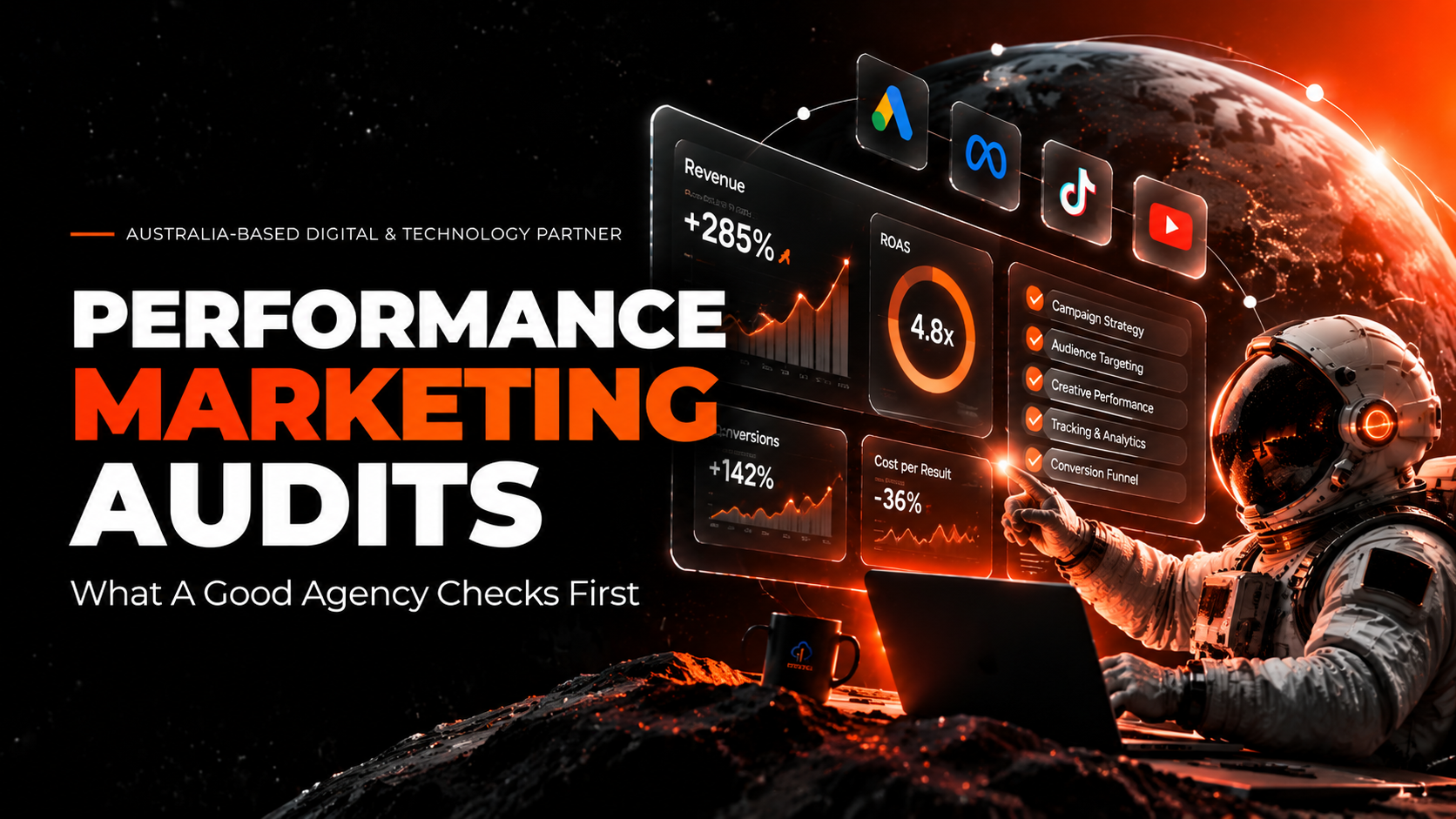
Most businesses only review their ads when results drop. By then, budget has often been leaking for months. A performance marketing audit finds the leaks before they get expensive.
If you run paid campaigns in Australia, you probably have questions. Is my tracking accurate? Is my ad spend working? Why is my cost per acquisition rising?
A good agency doesn’t start by tweaking bids. It starts by checking whether the data you’re relying on is even true.
This guide explains what a performance marketing audit is and what a good agency checks first, in the order they check it. You’ll also see the red flags, the costs, and how to judge an agency’s audit. Use it to review your own accounts or to hold an agency to a higher standard.
What Is a Performance Marketing Audit?
A performance marketing audit is a structured review of your paid advertising, tracking, funnel and reporting. It answers one question: is every dollar of ad spend working as hard as it should?
It usually covers:
- Google Ads, Meta Ads, LinkedIn, TikTok and other paid channels
- Conversion tracking and analytics setup
- Campaign and ad account structure
- Audiences, creative and landing pages
- Budget allocation and return on ad spend (ROAS)
- Attribution and reporting accuracy
Performance Marketing Audit vs Digital Marketing Audit
A digital marketing audit is broader. It can include SEO, email, social content, website UX and brand presence. A performance audit is narrower and more numbers-driven. It focuses on measurable outcomes like leads, sales, cost per acquisition (CPA) and customer acquisition cost (CAC).
Performance Audit vs Brand Audit
A brand audit looks at perception, messaging and awareness. A performance audit looks at what your ad accounts deliver against targets. Both matter, but they answer different questions.
Why a Performance Marketing Audit Matters
Paid media rewards precision. Small mistakes compound quickly when you’re paying per click.
Here is why an audit pays for itself:
- It exposes wasted ad spend. Irrelevant search terms, overlapping audiences and dead campaigns quietly drain budget.
- It protects your data. Broken tracking leads to bad decisions, and bad decisions cost more than bad ads.
- It reveals growth headroom. Often the fastest gains come from fixing what exists, not spending more.
- It builds accountability. An audit gives you a clear baseline to measure any agency, including your current one.
- It reduces risk. Privacy changes, platform updates and browser restrictions keep shifting how tracking works. Regular audits keep you ahead of them.
Australian advertisers face a few extra pressures. Competition in metro markets pushes up cost per click. Privacy expectations are rising. Many local businesses run lean budgets where every wasted dollar matters.
What a Good Agency Checks First
The order matters. Strong agencies audit from the foundation upward. There is no point optimising ads if the numbers behind them can’t be trusted.
Step 1: Business Goals and Unit Economics
Before opening any ad account, a good agency asks:
- What does a customer or lead actually cost you to acquire?
- What is a customer worth over time (lifetime value)?
- What margin can you afford to spend on ads?
- What targets are you measuring against?
This sets the benchmark for everything else. A campaign with a 3x ROAS might be excellent for one business and a disaster for another. Without your margins, “good performance” has no definition.
Quick example: A store selling a product with a 30% margin needs a much higher ROAS to be profitable than one with a 70% margin. The audit should say clearly what “break-even ROAS” is for you.
Step 2: Conversion Tracking and Data Integrity
This is the most critical part of any audit. If tracking is wrong, every report is wrong.
A conversion tracking audit checks:
- Are the right actions being counted as conversions?
- Are conversions being counted twice?
- Is Google Analytics 4 (GA4) set up correctly, with events and conversions properly defined?
- Is Google Tag Manager (GTM) clean, or full of old, conflicting tags?
- Is the Meta Pixel firing correctly, and is the Conversions API (CAPI) in place?
- Are you using enhanced conversions or server-side tracking to recover lost signals?
- Do your ad platform numbers roughly match your CRM or sales data?
Common issues agencies find:
- “Micro-conversions” like page views counted as sales
- Duplicate purchase events inflating ROAS
- Tags firing on the wrong pages
- No offline conversion import for phone or in-store leads
- Consent settings blocking large amounts of data
Fixing tracking often changes performance reports overnight. That can be uncomfortable, but it’s the truth you need.
Step 3: Account Structure and Campaign Architecture
Next, the agency looks at how your account is built. Good campaign structure makes performance easier to manage and scale.
Key checks:
- Are campaigns separated by intent, product or funnel stage?
- Are brand and non-brand search campaigns split?
- Do campaigns cannibalise each other?
- Are budgets sensible for each campaign’s goal?
- Are naming conventions clear enough for anyone to follow?
A messy account usually signals messy thinking. It also makes testing harder, because you can’t isolate what’s working.
Step 4: Budget Allocation and Wasted Spend
Here the agency follows the money. This is where many clients see the quickest wins.
A good agency will:
- Rank campaigns by cost per acquisition and ROAS
- Identify campaigns spending heavily with little return
- Spot budget-limited campaigns that are performing well
- Check device, location, time and audience splits
- Review search terms for irrelevant traffic
For Google Ads, the negative keywords list is a major check. If you’re paying for clicks on “free”, “jobs” or “DIY” searches when you sell premium services, that’s wasted ad spend in its purest form.
Step 5: Audience Targeting and Remarketing
Now the agency examines who your ads reach.
Checks include:
- Are audiences too broad or too narrow?
- Is there audience overlap between campaigns or ad sets?
- Are existing customers being excluded from acquisition campaigns?
- Are remarketing audiences sized, refreshed and segmented sensibly?
- Is frequency too high, causing ad fatigue?
Overlap is a silent problem. Two ad sets targeting similar people bid against each other, driving up costs for both.
Step 6: Ad Creative and Messaging
Creative is now the biggest performance lever on platforms like Meta and TikTok. A good creative testing review looks at:
- How many creative variations are running?
- Is there a clear testing process, or just random changes?
- Are there signs of creative fatigue, such as falling click-through rate (CTR) and rising cost?
- Do the ads match each funnel stage?
- Is the offer clear, specific and believable?
For search ads, the agency checks ad copy relevance, asset coverage (sitelinks, callouts, structured snippets) and whether headlines reflect what people actually search for.
Step 7: Landing Pages and Conversion Rate Optimisation
Great ads can’t save a weak landing page. Agencies review landing page performance for:
- Page speed on mobile
- Message match between ad and page
- Clear call to action
- Form length and friction
- Trust signals such as reviews, guarantees and secure checkout
- Mobile usability
A page that converts at 1.5% instead of 3% effectively doubles your acquisition costs. Conversion rate optimisation (CRO) and A/B testing are often the cheapest way to lift results.
Step 8: Attribution and Reporting
Finally, the agency checks how success is measured and reported.
- Which attribution model is being used, and is it appropriate?
- Are platforms over-claiming credit for the same sale?
- Is there a single source of truth for reporting?
- Do reports show business outcomes or just vanity metrics?
- Are marketing KPIs tied to revenue, not only clicks?
Each platform tends to take credit for conversions it influenced. Without cross-checking against analytics or CRM data, your total reported conversions can exceed your actual sales.
Google Ads Audit: Specific Checks
If Google is your main channel, a dedicated Google Ads audit looks at extra details:
- Match types: Are broad match keywords running without enough control?
- Quality Score: Are relevance and expected CTR healthy?
- Search terms report: Is traffic relevant?
- Bidding strategy: Is the smart bidding goal aligned with real conversions?
- Performance Max: Is it cannibalising brand search or hiding poor placements?
- Auction insights: Who are you competing against, and where are you losing impression share?
- Location settings: Are you targeting “people in” or “people interested in” your area?
That last one catches many local businesses. A wrong location setting can send budget to people who will never buy.
Meta Ads Audit: Specific Checks
A Meta Ads audit focuses on:
- Pixel and Conversions API event quality
- Account structure (consolidated vs fragmented ad sets)
- Audience overlap and exclusions
- Creative variety and fatigue
- Placement performance
- Learning phase issues from tiny budgets spread across too many ad sets
- Lead quality for lead-gen campaigns
Meta can generate cheap leads that never convert. A good audit follows leads through to sales instead of stopping at cost per lead.
Tools and Benefits of a Professional Audit
Agencies typically combine platform data with dedicated tools. Common ones include:
- Google Ads and Meta Ads Manager native reporting
- Google Analytics 4
- Google Tag Manager and tag debugging tools
- Looker Studio for reporting
- Heatmap and session recording tools for landing pages
- Spreadsheet models for unit economics
- CRM data for lead quality analysis
Benefits You Can Expect
- Clearer view of what’s working
- Lower wasted spend
- More reliable data
- Prioritised action plan with quick wins and longer-term fixes
- Stronger foundation for scaling
- Better conversations with your agency or internal team
Scope, Demand and Cost in Australia
Demand for performance marketing expertise in Australia keeps growing. More businesses shifted budget into digital channels, and they now want proof of return rather than impressions.
What Affects Audit Scope
- Number of channels and accounts
- Monthly ad spend
- Complexity of tracking
- Ecommerce catalogue size or lead-gen sales cycle
- Depth of landing page and CRO review
What Does an Audit Cost?
Pricing varies widely. Some agencies offer a free marketing audit as a lead generation tool. Others charge a fixed fee for a detailed, documented review. Larger accounts with complex tracking can cost more.
Is a free audit worth it? It can be, as a starting point. Just understand its limits. Free audits are often surface-level and designed to open a sales conversation. A paid audit is usually deeper, with access to your actual accounts and a documented action plan. Ask what’s included before you agree to either.
How Long Does an Audit Take?
Small accounts can take a few days. Larger, multi-channel setups can take two to three weeks, especially if tracking needs deep investigation.
Red Flags in Performance Marketing Accounts
These signs suggest an audit is overdue:
- Your reported conversions don’t match your actual sales
- Cost per acquisition keeps rising with no clear reason
- You can’t explain what each campaign is for
- One campaign eats most of the budget
- Creative hasn’t changed in months
- Nobody has reviewed search terms recently
- Your agency reports clicks and impressions, not revenue
- You don’t have access to your own ad accounts
- Landing pages are the same for every campaign
- Tracking was set up years ago and never checked
If three or more apply, an audit should be a priority.
Digital Advertising Audit for Small Business
Small businesses face different challenges from large advertisers. Budgets are limited, and one bad campaign can hurt.
A useful digital advertising audit for small business focuses on:
- Making sure the business owns its ad accounts and data
- Cutting waste first, before adding spend
- Simple, reliable tracking for calls, forms and bookings
- Strong local targeting
- A short, prioritised list of actions rather than a 60-page report
Tip: With a small budget, consolidate. Fewer, well-structured campaigns almost always beat many thin ones.
Marketing Audit for Ecommerce
An ecommerce audit adds product-level thinking:
- Product feed quality and Google Merchant Center health
- Margin-aware bidding by product or category
- Purchase tracking accuracy
- Abandoned cart and post-purchase remarketing
- Customer lifetime value and repeat purchase rate
- Checkout friction
Ecommerce accounts often show a gap between platform-reported ROAS and real profit. An audit closes that gap.
Why Choose System Digital
Choosing who audits your ads matters as much as the audit itself. System Digital approaches performance marketing with a measurement-first mindset. That means tracking is checked before strategy is changed, and recommendations are tied to business outcomes, not vanity metrics.
Here’s what that looks like in practice:
- Transparent process: You see what was reviewed and why.
- Actionable outcomes: Findings are prioritised by impact and effort.
- Australian market focus: Recommendations reflect local competition, buying behaviour and privacy expectations.
- Clear reporting: Results are explained in plain language.
Want to see how this works? Read more on Why choose System Digital, or Explore Advanced services at System Digital.
How to Learn Performance Marketing Auditing (Free and Paid)
If you want to build audit skills yourself, or understand what your agency is doing, there are good starting points.
Free Resources
- Google Skillshop: Free certifications for Google Ads and Analytics
- Meta Blueprint: Free courses on Meta advertising
- Google Analytics Help Centre: Official documentation on GA4 setup and events
- Official platform blogs: Product updates and best practice guidance
- YouTube tutorials: Walkthroughs of account audits and tracking setup
Paid Options
- Structured courses that teach audit frameworks end to end
- Industry certifications
- Mentorship or agency-led training
- Workshops with hands-on account reviews
A Simple Way to Start
- Learn your platform’s reporting basics
- Practise on a small test account
- Build your own audit checklist
- Compare platform data with analytics data
- Review one account monthly and track your findings
For authoritative technical guidance on measurement, the Google Analytics Help Centre is a reliable reference.
Real-World Examples
These are illustrative scenarios based on common audit findings.
Example 1: The Inflated ROAS
An ecommerce store saw a platform ROAS that looked strong. The audit found the purchase event was firing on both the checkout page and the thank-you page. Every sale was counted twice. After fixing tracking, reported ROAS dropped sharply, but the business finally saw the real numbers. Budget was then reallocated to what genuinely worked.
Example 2: The Local Service Business
A service business was paying for clicks across an entire state. The audit found location targeting set to “interest in” rather than “presence in”, plus a thin negative keyword list. Tightening both cut irrelevant clicks and lowered cost per lead.
Example 3: The Fatigued Creative
A lead-gen advertiser saw click-through rates fall week after week. The audit showed the same three ads running for months to a small audience. A creative testing plan and refreshed audiences stabilised cost per lead.
In each case, the fix wasn’t more budget. It was better data and structure.
Performance Marketing Audits Across Australian Cities
Local competition shapes how audits are approached.
- Sydney: High competition and high costs mean efficiency is critical. Audits often focus on wasted spend and impression share.
- Melbourne: Strong ecommerce and retail activity makes product-level performance and creative testing key.
- Brisbane: Growing service and property sectors benefit from tight local targeting and lead quality reviews.
- Perth: Resources, trades and local services often need accurate call and form tracking.
- Adelaide: Smaller market pools make audience overlap and frequency especially important.
Whether you’re searching for a performance marketing agency in Sydney, Melbourne, Brisbane, Perth or Adelaide, or working with a national team, the audit principles stay the same. What changes is the local context.
Future Opportunities in Performance Marketing in Australia
The field keeps evolving, and audits are evolving with it.
Trends shaping what agencies check:
- Privacy and consent: More reliance on first-party data and server-side tracking
- AI-driven campaigns: Automation needs stronger inputs and oversight
- Creative as the main lever: Testing volume and quality matter more
- Blended measurement: Combining platform data, analytics, and marketing mix thinking
- Profit-based optimisation: Moving from ROAS alone to margin and lifetime value
For professionals, this means growing demand for analysts, paid media specialists and measurement experts who can audit and explain performance. Skills in tracking, analytics and CRO are increasingly valuable.
For businesses, regular audits are becoming a normal part of running paid media, much like financial reviews.
Frequently Asked Questions
What is a performance marketing audit?
A performance marketing audit is a structured review of your paid advertising, tracking, funnel and reporting. It identifies wasted spend, data issues and growth opportunities across channels like Google Ads and Meta Ads.
What does a performance marketing audit include?
It typically includes goals and KPIs, conversion tracking, account structure, budget allocation, audiences, creative, landing pages and attribution. The result is a prioritised action plan.
What is the first thing an agency checks in a PPC audit?
Most good agencies check conversion tracking and data accuracy first. If the data is unreliable, every other decision built on it is unreliable too.
How often should you audit paid media campaigns?
A full audit is worthwhile at least once or twice a year. Lighter monthly or quarterly health checks help catch issues early, especially after major platform or website changes.
How do I know if my ad spend is being wasted?
Warning signs include rising cost per acquisition, irrelevant search terms, conversions that don’t match real sales, overlapping audiences and stale creative. An audit confirms where the waste is.
How much does a digital marketing audit cost in Australia?
Costs vary with account size, channels and depth. Some agencies offer free introductory audits, while comprehensive paid audits are priced by scope. Ask exactly what’s included before agreeing.
Conclusion: Start With the Foundation
A strong performance marketing audit doesn’t begin with tactics. It begins with trust in your data, clarity on your numbers and a structure that lets you scale confidently.
The best agencies check tracking first, then structure, spend, audiences, creative, landing pages and attribution. That sequence turns guesswork into decisions you can defend.
If you suspect your ads could work harder, an audit is the smartest place to start.
Ready to find out where your budget is going? Book a seat at Advance Services offered by System Digital.