


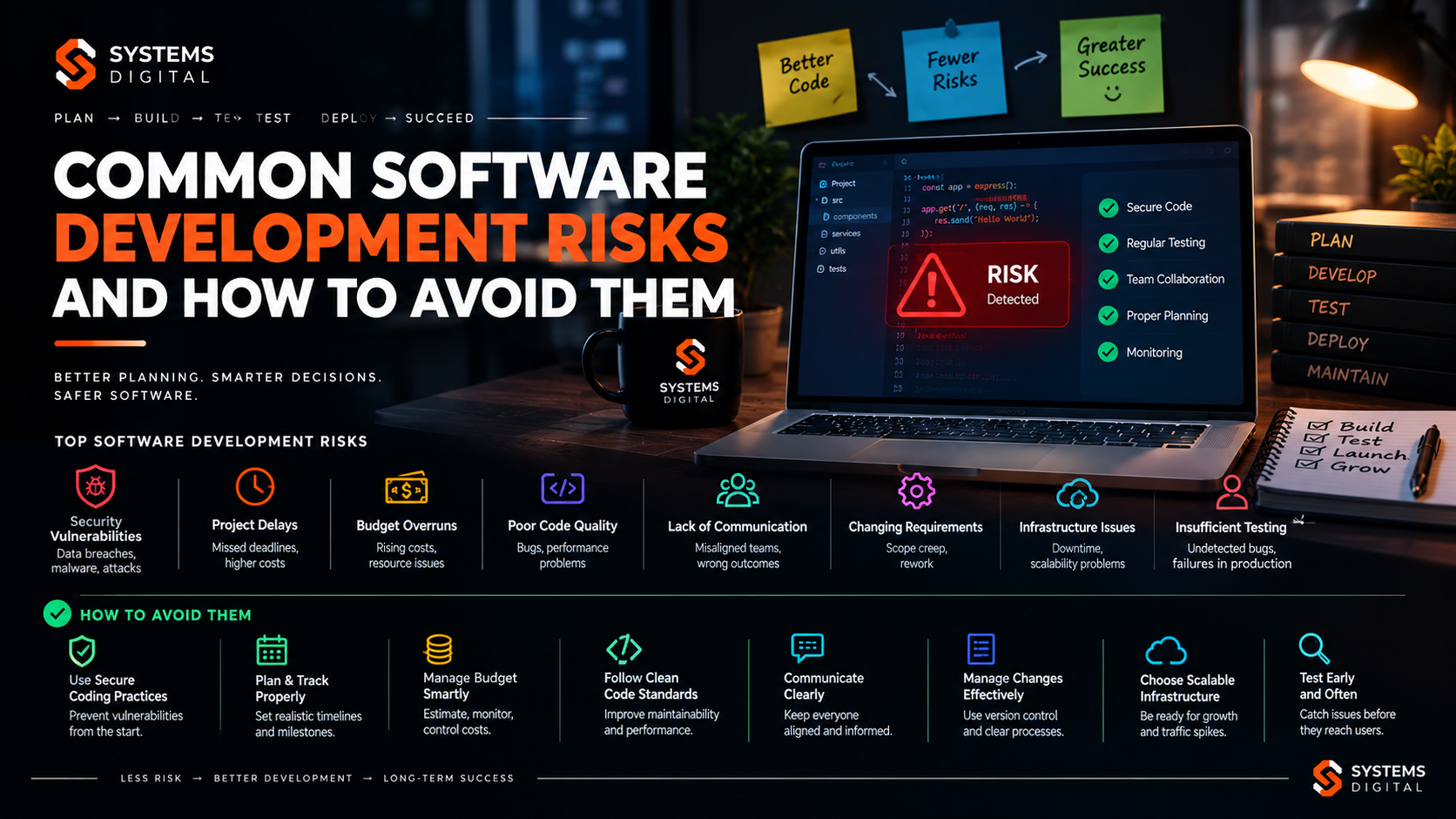
Every software project starts with confidence and a clear goal. Then reality arrives. Requirements shift, deadlines tighten, a key developer leaves, and a security gap appears at the worst possible moment.
These problems are not signs of bad luck. They are software development risks, and they show up in projects of every size, from small business apps to enterprise platforms.
The good news is that most of these risks are predictable. With early risk identification, a clear plan and disciplined delivery, you can avoid most of them or limit the damage.
This guide covers the most common software development risks, why they happen and how to avoid them. It also covers what Australian businesses need to consider around compliance, security and choosing a delivery partner.
What Are Software Development Risks?
Software development risks are uncertain events or conditions that can harm a project’s scope, budget, timeline, quality or security. If a risk is ignored, it can turn into an issue that needs urgent, costly attention.
Risks in software development usually fall into five groups:
- Project risks: scope creep, unrealistic deadlines, poor planning and budget overruns.
- Technical risks: weak architecture, technical debt, integration problems and scalability limits.
- People and resource risks: skill gaps, team turnover and poor communication.
- Security and compliance risks: cybersecurity vulnerabilities, data breaches and privacy law breaches.
- External risks: vendor failure, changing regulations and third-party dependencies.
A risk is something that might happen. An issue is something that has happened. Software development risk management is the practice of catching risks while they are still only possibilities.
Why Managing Software Development Risks Matters
Many software projects struggle. Industry research, including the Standish Group’s long-running CHAOS reports, has repeatedly found that only a minority of large software projects finish fully on time, on budget and with the promised scope.
Here is why risk management is worth the effort.
- It protects your budget. Fixing a problem late costs far more than preventing it early.
- It keeps delivery on track. Early warning signs let you adjust before a delay becomes a crisis.
- It improves quality. Planned testing and review reduce the number of defects that reach customers.
- It protects your reputation. A data breach or major outage damages customer trust quickly.
- It supports better decisions. Leaders can weigh trade-offs with real information instead of guesses.
For Australian businesses, there is a legal side too. Privacy and cybersecurity obligations make poor risk management a compliance problem as well as a technical one.
12 Common Software Development Risks (and How to Avoid Them)
Here are the most common software development risks, with practical ways to prevent or reduce each one.
1. Scope Creep
Scope creep is the slow growth of a project beyond its original goals. It usually starts with small requests like “Can we just add one more feature?” Over time, these additions stretch the project timeline and budget.
How to avoid it:
- Write a clear scope statement before development begins.
- Set up a formal change control process so every new request is assessed for cost, time and impact.
- Use a minimum viable product (MVP) approach. Launch the core features first, then add more based on real user feedback.
- Keep a visible backlog so stakeholders can see that ideas are captured, not ignored.
2. Unclear or Changing Requirements
Poor requirements gathering is one of the biggest software project failure reasons. If the team builds something based on assumptions, the result rarely matches what the business needs.
How to avoid it:
- Run discovery workshops with every stakeholder group, not just senior managers.
- Write requirements as user stories with clear acceptance criteria.
- Use prototypes and wireframes so people can react to something visual early.
- Review requirements regularly, and document every approved change.
3. Budget Overruns
Budget overruns often come from poor estimation, hidden complexity and unmanaged scope changes. Many teams also forget to budget for testing, security reviews, documentation and post-launch support.
How to avoid it:
- Estimate in ranges, not single numbers, and add a contingency buffer.
- Break the project into phases with their own budget checkpoints.
- Track actual spend against forecasts every sprint or month.
- Include maintenance and hosting in the total cost of ownership.
4. Project Delays and Missed Deadlines
Project delays are rarely caused by one big event. More often, small slips build up until the project timeline falls apart.
How to avoid it:
- Build timelines from detailed task estimates made by the people doing the work.
- Identify the critical path and watch it closely.
- Add schedule buffers for testing, reviews and approvals.
- Hold short, regular progress reviews so slippage is visible early.
5. Technical Debt
Technical debt builds up when teams take shortcuts to deliver faster. A quick fix today becomes a harder, more expensive problem tomorrow. Over time, the codebase becomes difficult to change, and new features slow to a crawl.
How to avoid it:
- Set coding standards and enforce them through code review.
- Schedule regular refactoring time in every sprint.
- Track known shortcuts in a visible debt register.
- Use static analysis tools to flag code quality issues automatically.
6. Poor Quality Assurance and Insufficient Testing
Skipping or rushing software testing is a common way to meet a deadline. It almost always costs more later, through production bugs, unhappy users and emergency fixes.
How to avoid it:
- Build quality assurance (QA) into every stage of development, not just the end.
- Combine automated testing (unit, integration and regression) with manual exploratory testing.
- Run performance and load testing before major launches.
- Complete user acceptance testing with real users before go-live.
7. Cybersecurity Vulnerabilities
Security gaps in software can lead to data breaches, financial loss and legal trouble. Common causes include insecure code, weak authentication, unpatched libraries and misconfigured cloud services.
How to avoid it:
- Follow secure coding practices from the first line of code, not as a final check.
- Run vulnerability scanning and penetration testing before launch and at regular intervals.
- Keep libraries and dependencies updated.
- Apply the principle of least privilege to systems, data and staff access.
- Use the Australian Cyber Security Centre’s guidance as a baseline (more on this below).
8. Data Security and Compliance Risks
Software that handles personal information must meet legal requirements. In Australia, that includes the Privacy Act 1988 and the Australian Privacy Principles (APPs). The Notifiable Data Breaches scheme also requires certain breaches to be reported.
How to avoid it:
- Complete a privacy impact assessment during the design stage.
- Collect only the data you need, and store it securely.
- Encrypt data in transit and at rest.
- Prepare a data breach response plan before you need it.
- Check industry-specific rules, such as those for finance and health.
9. Team Turnover and Skill Gaps
If a key developer leaves mid-project, knowledge can disappear with them. Skill gaps create similar problems. A team without the right expertise will struggle with complex architecture, security or cloud decisions.
How to avoid it:
- Maintain clear technical documentation so knowledge is not locked in one person’s head.
- Use pair programming and code reviews to spread understanding.
- Cross-train team members on critical systems.
- Fill skill gaps early with training or specialist partners.
10. Third-Party Integrations and Vendor Lock-In
Modern software relies on APIs, cloud platforms and external services. Third-party integrations save time, but they add dependency risk. A vendor can change pricing, retire a feature or suffer an outage. Vendor lock-in can also make it costly to switch later.
How to avoid it:
- Assess vendor stability, support and security before committing.
- Use abstraction layers so you can swap services with less rework.
- Read contracts carefully for exit terms and data portability.
- Monitor third-party service health, and plan fallback options.
11. Poor Communication and Weak Stakeholder Management
Many projects fail because of people, not code. If stakeholder communication is irregular or unclear, expectations drift apart from reality.
How to avoid it:
- Agree on a communication plan covering who gets what update and how often.
- Hold regular demos so stakeholders see real progress.
- Use one shared source of truth for status, decisions and documents.
- Escalate risks early and honestly.
12. Scalability, Deployment and Maintenance Risks
Software that works for 100 users may fail at 10,000. Deployment mistakes can also cause outages, and neglected maintenance lets small issues grow.
How to avoid it:
- Design the architecture for expected growth, not just current needs.
- Use DevOps and CI/CD pipelines to automate builds, tests and releases.
- Prepare rollback plans for every release.
- Set up post-launch monitoring and a maintenance schedule.
Software Development Lifecycle Risks at a Glance
Different risks dominate at different stages of the software development lifecycle (SDLC). This table shows where to focus.
| SDLC Stage | Main Risks | Key Prevention Step |
|---|---|---|
| Planning | Unrealistic scope, poor estimates | Detailed discovery and phased budgets |
| Requirements | Unclear or changing needs | User stories, prototypes, sign-off |
| Design | Weak architecture, scalability gaps | Architecture review, security by design |
| Development | Technical debt, code defects | Code review, coding standards |
| Testing | Insufficient coverage | Automated and user acceptance testing |
| Deployment | Release failures, downtime | CI/CD, rollback plan |
| Maintenance | Neglected updates, security drift | Monitoring, patching schedule |
Agile Software Development Risks
Agile methods help teams respond to change, but they have their own pitfalls.
- Endless scope growth: flexibility can turn into uncontrolled additions.
- Weak documentation: speed sometimes pushes documentation aside.
- Unclear priorities: without a strong product owner, the backlog becomes a wish list.
- Hard-to-predict budgets: fixed costs are harder to forecast when scope is fluid.
How to mitigate risks in agile development:
- Appoint an empowered product owner to prioritise the backlog.
- Define a clear “definition of done” for every story.
- Review risks in sprint planning and retrospectives.
- Keep just enough documentation to support handover and compliance.
How to Build a Software Project Risk Management Plan
A software project risk management plan turns good intentions into a repeatable process. Here is a simple, effective approach.
- Identify risks. Run a workshop with developers, testers, business owners and security staff. Review lessons from past projects.
- Assess likelihood and impact. Score each risk, for example low, medium or high.
- Prioritise. Focus first on risks that are both likely and damaging.
- Plan responses. Choose to avoid, reduce, transfer or accept each risk.
- Assign owners. Every risk needs one named person responsible for it.
- Monitor and review. Revisit the plan regularly, because risks change as the project evolves.
What Is a Software Development Risk Register?
A software development risk register is a living document that tracks every identified risk. It keeps the whole team aligned and makes risk discussions concrete.
A basic risk register includes:
| Risk | Likelihood | Impact | Mitigation | Owner | Status |
|---|---|---|---|---|---|
| Scope creep | High | High | Change control process | Project manager | Open |
| Key developer leaves | Medium | High | Documentation, cross-training | Tech lead | Monitoring |
| Security vulnerability | Medium | Very high | Penetration testing, secure coding | Security lead | Open |
| Third-party API change | Low | Medium | Abstraction layer, vendor monitoring | Architect | Monitoring |
Software Development Risk Assessment Checklist
Use this quick checklist at the start of any project:
- Are scope and success criteria written down and approved?
- Have all key stakeholders been involved in requirements?
- Does the budget include testing, security, documentation and support?
- Is there a named owner for each major risk?
- Is there a process for managing change requests?
- Are security and privacy requirements defined?
- Do we have backup plans for key people and key vendors?
- Is the release and rollback process tested?
Key Skills, Tools and Benefits of Strong Risk Management
Skills That Reduce Risk
- Analytical thinking to spot patterns and weak points early.
- Clear communication to explain risks in plain language.
- Technical judgement to balance speed, quality and cost.
- Negotiation and stakeholder management to keep expectations realistic.
Tools That Help
- Project management tools such as Jira, Azure DevOps or Trello to track tasks, risks and progress.
- Version control such as Git to manage code changes safely.
- CI/CD pipelines to automate testing and deployment.
- Static analysis and security scanners to catch defects and vulnerabilities early.
- Monitoring tools to detect performance issues after launch.
Benefits You Can Expect
- Fewer surprises during delivery.
- More predictable budgets and timelines.
- Higher software quality and user satisfaction.
- Stronger security and compliance.
- Greater confidence from leadership and customers.
Software Development Risk Management in Australia
Australian businesses face some specific considerations when planning software projects.
Privacy and Compliance
The Privacy Act 1988 and the Australian Privacy Principles set rules for how organisations collect, store, use and disclose personal information. Penalties for serious or repeated privacy breaches have increased in recent years, so this is a board-level concern, not just an IT task. Always confirm your current obligations with a qualified legal adviser.
The Essential Eight
The Australian Cyber Security Centre (ACSC) publishes the Essential Eight, a set of practical mitigation strategies. They include application control, patching applications, restricting administrative privileges and regular backups. Many organisations use it as a baseline for secure software development and cyber resilience. You can read the official guidance on the ACSC Essential Eight page.
Local Delivery and Support
Time zones, contracts, data residency and support hours all matter. Many Australian businesses prefer custom software development partners with local presence in cities such as Sydney, Melbourne, Brisbane, Perth and Adelaide. This makes collaboration, workshops and accountability easier.
Risks of Outsourcing Software Development
Outsourcing can speed up delivery and give access to specialist skills. It also brings extra risks.
- Communication gaps across time zones and cultures.
- Quality inconsistency if standards are not clearly defined.
- Intellectual property and data security concerns, especially offshore.
- Hidden costs from unclear contracts and change fees.
- Dependency on a single supplier.
How to manage them:
- Write detailed contracts covering scope, ownership, security and exit terms.
- Check the provider’s track record, references and security practices.
- Set clear milestones, reporting and acceptance criteria.
- Keep documentation and source code accessible to you at all times.
- Start with a small pilot before committing to a large engagement.
How to Choose a Reliable Software Development Company
The right partner is one of your best risk controls. When comparing providers, look for:
- Proven experience in projects similar to yours.
- A transparent process covering discovery, planning, testing and support.
- Security and compliance awareness, including Australian requirements.
- Clear communication, with regular updates and honest reporting.
- Strong references and case studies from real clients.
- Post-launch support and a clear maintenance model.
Ask each provider how they handle scope changes, how they manage risk and what happens if something goes wrong. Good partners answer these questions openly.
Real-World Examples of Software Development Risks
Learning from past failures helps you avoid repeating them.
Knight Capital (2012)
A faulty software deployment at the US trading firm Knight Capital caused unintended trades. The company lost roughly US$440 million in under an hour. The lesson: deployment risks and weak release controls can be devastating.
Healthcare.gov (2013)
The US government’s health insurance website launched with serious performance and reliability problems. Reports pointed to unclear requirements, complex vendor coordination and insufficient testing before launch. The lesson: testing and governance cannot be rushed.
Queensland Health Payroll
This well-known Australian project aimed to replace a payroll system but ran into major problems. Staff were paid incorrectly, and total costs grew far beyond the original budget, reaching well over a billion dollars. The lesson: poor planning, unclear requirements and weak project governance can turn a software project into a public crisis.
2016 Australian Census Outage
The online Census site went offline on census night, which led to widespread public criticism. The event highlighted the importance of capacity planning, resilience testing and incident preparedness.
Each of these examples traces back to risks covered in this guide: scope, testing, governance, scalability and security.
Why Choose System Digital
Managing software development risk takes more than good intentions. It takes experience, structure and the right team.
At System Digital, we help Australian businesses plan, build and maintain software with risk management built into every stage. If you want to know what sets us apart, see Why choose System Digital for our approach, values and delivery process.
Here is what you can expect when you work with us:
- Clear discovery and planning to reduce unclear requirements and scope creep.
- Quality assurance built into delivery, not added at the end.
- Security-first thinking aligned with Australian requirements.
- Transparent communication with regular updates and demos.
- Ongoing support so your software stays secure, fast and reliable.
You can also Explore Advanced services at System Digital to see how we support businesses beyond the initial build.
How to Learn Software Risk Management (Free and Paid Resources)
Whether you are a founder, product owner, project manager or developer, these resources can build your skills.
Free Resources
- Australian Cyber Security Centre (cyber.gov.au): guidance on the Essential Eight and secure practices.
- Office of the Australian Information Commissioner (oaic.gov.au): privacy obligations and breach guidance.
- OWASP (owasp.org): free resources on application security, including the well-known OWASP Top 10.
- Atlassian Agile Coach and similar guides: free articles on agile planning and risk.
- YouTube and community channels: talks on DevOps, testing and project delivery.
Paid Courses and Certifications
- PMP or PRINCE2 for formal project and risk management.
- Certified ScrumMaster (CSM) or SAFe for agile delivery practices.
- ISTQB for software testing foundations.
- CISSP or CompTIA Security+ for security-focused roles.
- Cloud certifications from AWS, Microsoft Azure or Google Cloud for infrastructure risk.
Check each provider’s current course details and pricing before enrolling.
Career Opportunities in Australia: Risk-Aware Software Roles
Strong risk management skills are valuable across the technology industry. Demand continues for professionals who can deliver software safely, securely and on time.
Roles That Use These Skills
- Software project manager or delivery manager
- Scrum master or agile coach
- QA engineer or test lead
- DevOps engineer
- Security analyst or application security engineer
- Business analyst
- Solutions architect
- Technical product manager
Salary and Demand
Salaries vary by city, industry, experience and certifications. Experienced software engineers, delivery leads and security specialists in Australia commonly earn six-figure salaries, especially in Sydney and Melbourne. For up-to-date numbers, check current listings on Seek or LinkedIn and recent salary guides from recruitment firms.
Demand is strongest where businesses are investing in digital transformation, cloud migration and cybersecurity. Professionals who combine technical knowledge with risk awareness stand out in these markets.
Frequently Asked Questions
What are the main risks in software development?
The main risks include scope creep, unclear requirements, budget overruns, project delays, technical debt, poor testing, security vulnerabilities, compliance failures, team turnover and third-party dependencies. Most can be reduced with early planning, clear communication and regular risk reviews.
How do you manage risk in software development?
Identify risks early, assess their likelihood and impact, and prioritise the most serious ones. Then assign owners, plan responses and track everything in a risk register. Review the register regularly, because risks change throughout the project.
Why do most software projects fail?
Most software projects fail because of unclear requirements, uncontrolled scope changes, unrealistic estimates, weak communication and insufficient testing. Technical problems matter, but people and process issues are often the root cause.
What is scope creep in software development?
Scope creep is the gradual expansion of a project beyond its original goals without matching changes to time, budget or resources. You can prevent it with a clear scope statement, a formal change control process and an MVP approach.
How can technical debt be reduced?
Reduce technical debt by enforcing coding standards, running code reviews, scheduling regular refactoring and tracking known shortcuts in a debt register. Automated testing also makes it safer to improve old code.
What are the risks of outsourcing software development?
The main risks are communication gaps, inconsistent quality, data and intellectual property concerns, hidden costs and over-reliance on one supplier. Clear contracts, defined milestones, strong security requirements and a small pilot project help reduce these risks.
Conclusion: Plan for Risk, and Deliver With Confidence
Software development will always involve uncertainty. The difference between a project that struggles and one that succeeds is how well the risks are understood and managed.
Start with clear requirements, a realistic plan and strong communication. Build quality and security into every stage, and review your risk register often. Choose delivery partners who are open about risk and accountable for results.
If you are planning a new software project, or want to rescue one that is off track, expert guidance can save you time, money and stress.
Ready to build software that is secure, reliable and delivered with confidence? Book a seat at Advance Services offered by System Digital and take the next step today.