

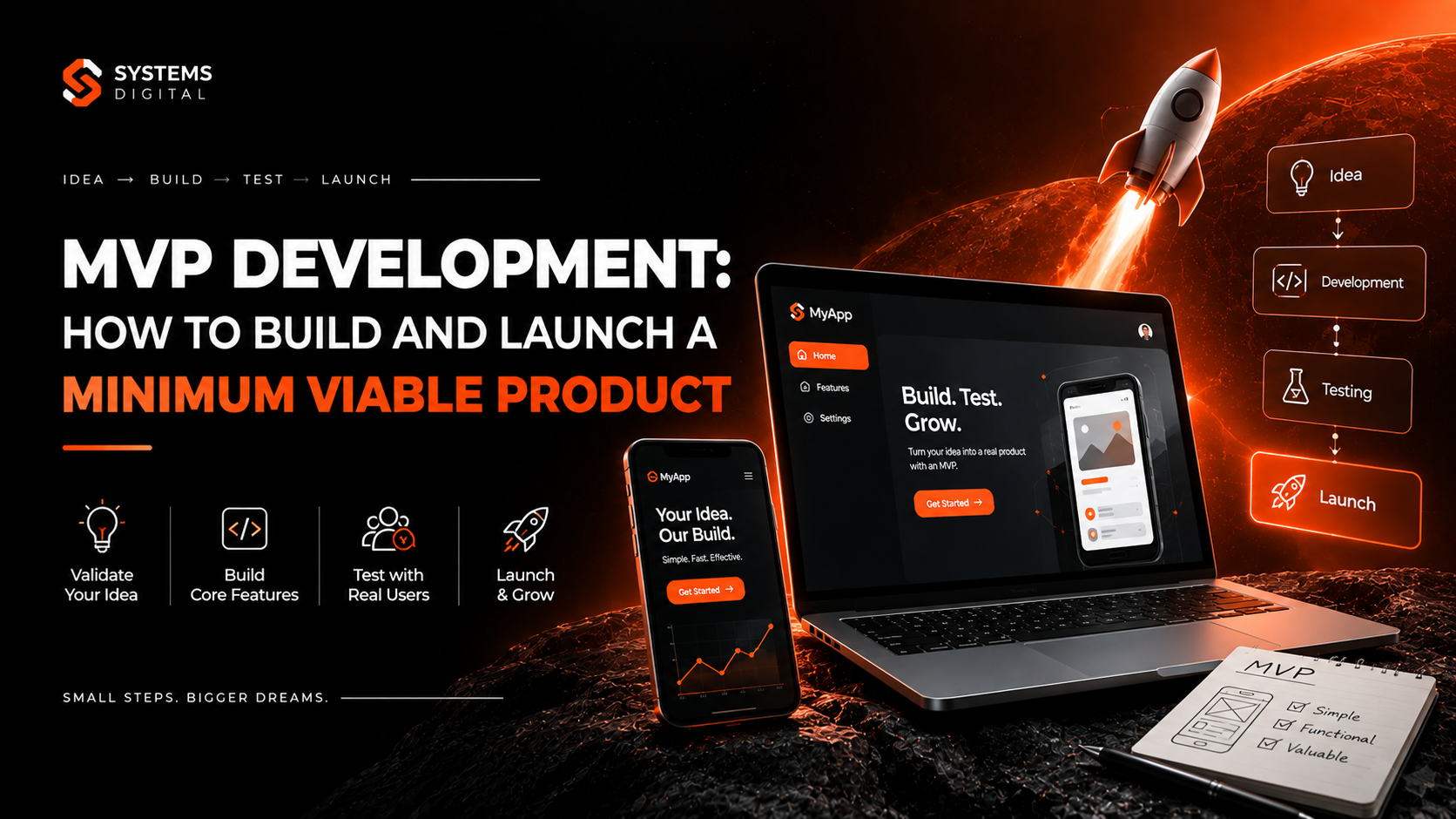
If you’ve ever had a business idea and wondered whether it’s actually worth building, you’re not alone. Every year, thousands of founders spend months — and their entire budget — building a “perfect” product, only to discover nobody wants it. That’s exactly the problem MVP development solves.
A Minimum Viable Product (MVP) lets you test your idea in the real world with real users, using the smallest amount of time, money, and effort possible. Instead of guessing what customers want, you build just enough to find out — then improve from there. In this guide, we’ll walk through what an MVP actually is, why it matters, how to build and launch one step by step, real-world examples, and where MVP development is headed in Australia and beyond.
What Is an MVP (Minimum Viable Product)?
An MVP, or minimum viable product, is the simplest version of a product that still delivers real value to early users while allowing a business to learn as much as possible about customer behaviour.
According to Eric Ries, the original creator of the term, “A Minimum Viable Product is that version of a new product which allows a team to collect the maximum amount of validated learning about customers with the least effort.” In other words, an MVP isn’t about building a smaller, cheaper product — it’s about building a smart product that answers a specific question: will people actually use and pay for this? mit
This idea sits at the centre of the lean startup methodology, which treats new product ideas as hypotheses to be tested rather than facts to be assumed. Instead of a linear “build it, then launch it” approach, MVP development follows a loop:
- Build — create the smallest usable version of your idea.
- Measure — release it to real users and track how they interact with it.
- Learn — use that data to decide whether to improve, pivot, or scale.
This build-measure-learn cycle repeats until the product finds genuine product-market fit.
MVP vs Prototype vs Proof of Concept (POC)
These three terms get confused constantly, so here’s the difference in plain language:
| Term | Purpose | Used by |
|---|---|---|
| Proof of Concept (POC) | Confirms an idea is technically possible | Internal team only |
| Prototype | Shows how the product will look and function | Internal team + stakeholders |
| MVP | A working product real customers can actually use | Real, paying or early-adopter customers |
A POC answers “can we build this?” A prototype answers “what will this look and feel like?” An MVP answers the most important question of all: “will anyone actually use this?”
Why MVP Development Matters
Skipping the MVP stage is one of the most common — and most expensive — mistakes startups make. Here’s why building an MVP first is worth the extra discipline.
- It reduces financial risk. You spend a fraction of a full product budget before knowing if the idea works.
- It speeds up time to market. You can launch in weeks instead of months, getting ahead of competitors.
- It generates real user feedback. Instead of assumptions, you get evidence about what customers actually want.
- It attracts investors. A working MVP with real users and early traction is far more convincing to investors than a pitch deck alone.
- It prevents building the wrong thing. Many startups fail not because they built their product badly, but because they built the wrong product entirely. An MVP catches that early.
Statistically, research on startup failure consistently points to “no market need” as one of the top reasons new products fail — precisely the risk an MVP is designed to catch before it becomes a costly mistake.
Key Skills, Tools, and Benefits of MVP Development
Building an effective MVP draws on a mix of strategic, design, and technical skills. Here’s what’s typically involved:
Core Skills Needed
- Product strategy and prioritisation — deciding what’s essential vs what can wait
- UX/UI design and wireframing — mapping the user journey before writing code
- Agile and lean development practices — working in short, iterative sprints
- Full-stack or no-code development — building the functional product itself
- Data analysis — interpreting user behaviour and feedback
- Customer discovery and validation — talking to real users, not just assuming
Common Tools Used in MVP Development
- Design & wireframing: Figma, Adobe XD, Sketch
- No-code/low-code platforms: Bubble, Webflow, Glide, FlutterFlow
- Development frameworks: React, Node.js, Flutter, Django
- Project management: Jira, Trello, Notion
- Analytics & feedback: Google Analytics, Hotjar, Mixpanel, Typeform
Key Benefits of Building an MVP
- Lower upfront development cost
- Faster feedback and faster pivots
- Easier to secure funding with proof of demand
- Reduced risk of large-scale product failure
- Clearer roadmap for future feature development
How to Build and Launch an MVP: Step-by-Step Process
Here’s a practical, step-by-step MVP development process you can follow from idea to launch.
Step 1: Identify the Problem You’re Solving
Every successful MVP starts with a clearly defined problem — not a feature list. Ask yourself: who is experiencing this problem, how painful is it, and how are they solving it today (if at all)?
Step 2: Research Your Target Market
Talk to potential customers before writing a single line of code. Customer discovery interviews, surveys, and competitor research help validate that the problem is real and worth solving.
Step 3: Define Your Core Value Proposition
What’s the one thing your product must do exceptionally well? Everything else is secondary. This becomes your MVP’s north star.
Step 4: Prioritise Features (Ruthlessly)
List every feature you could build, then cut it down to the few that are absolutely essential to delivering your core value proposition. A common framework here is MoSCoW prioritisation — Must have, Should have, Could have, Won’t have (yet).
Step 5: Choose Your Tech Stack
Decide whether you’ll build with a no-code platform (fast, cheaper, limited scalability) or custom code (more flexible, higher upfront cost). For most early-stage MVPs, speed matters more than perfection.
Step 6: Design the User Experience
Even a simple MVP needs a clean, intuitive user journey. Wireframe the core flow before development begins — this saves significant rework later.
Step 7: Build the MVP
Develop only the features identified in Step 4. Resist the temptation to “just add one more thing” — scope creep is the number one killer of MVP timelines.
Step 8: Test Internally
Run functional and usability testing before releasing to real users. Fix critical bugs, but don’t chase perfection — an MVP is expected to be simple, not flawless.
Step 9: Launch to Early Adopters
Release your MVP to a small, targeted group of early adopters — not the entire market. Early adopters are more forgiving of rough edges and more willing to give detailed feedback.
Step 10: Collect Feedback and Measure Usage
Use analytics tools and direct conversations to understand how people are actually using (or not using) your product.
Step 11: Iterate, Pivot, or Scale
Based on what you learn, you’ll typically do one of three things:
- Iterate — refine existing features based on feedback
- Pivot — change direction if the core idea isn’t resonating
- Scale — invest further because you’ve found genuine product-market fit
How Long Does It Take to Build an MVP?
Timelines vary depending on complexity, but as a general guide:
- Simple MVP (landing page, basic app, no-code build): 2–6 weeks
- Moderate MVP (custom app with core functionality): 6–12 weeks
- Complex MVP (multi-platform, integrations, custom backend): 3–6 months
The biggest factor affecting timeline isn’t technical difficulty — it’s scope discipline. MVPs that stay true to “minimum” launch faster than those that quietly grow into full products before release.
How Much Does MVP Development Cost?
MVP development cost depends heavily on approach:
- No-code MVP: Often $2,000–$15,000 depending on complexity
- Custom-built MVP (small team or agency): Typically $15,000–$60,000+
- Enterprise-grade MVP with complex integrations: $60,000 and up
Working with an experienced MVP development company can often reduce cost overruns, since experienced teams know how to scope tightly and avoid the rework that inflates budgets.
Why Choose System Digital for MVP Development
Building an MVP isn’t just about writing code — it’s about strategic prioritisation, fast execution, and knowing what not to build. This is where working with a dedicated team makes a measurable difference.
Why Choose System Digital as your MVP development partner comes down to a few things: a structured discovery process that avoids wasted development time, a team fluent in both no-code and custom development so you get the right tool for your budget, and a track record of helping startups go from idea to launched product without the scope creep that sinks most MVP timelines.
If your MVP succeeds and you’re ready to build further, you can explore Advanced Services at System Digital to scale your product with additional features, integrations, and infrastructure built for growth.
How to Learn MVP Development (Free and Paid Resources)
Whether you’re a founder or an aspiring product professional, there are strong resources for learning MVP development at every stage.
Free resources:
- The Lean Startup concept overview and blog resources at lean.org
- YouTube channels covering agile product development and lean UX
- Free tiers of tools like Figma and Bubble for hands-on practice
- Startup accelerator blogs (Y Combinator’s Startup School, for example)
Paid resources:
- Structured product management or UX bootcamps
- The Lean Startup and Running Lean (Ash Maurya) as foundational reading
- Paid courses on platforms like Coursera, Udemy, or specialised startup schools
- Working directly with an MVP development agency to learn through real project delivery
Reading is useful, but nothing teaches MVP development faster than building and launching one — even a small personal project.
Real-World MVP Examples
Some of today’s biggest companies started as surprisingly simple MVPs:
- Airbnb began as a basic website renting air mattresses in a founder’s apartment — no booking platform, no payment automation, just a way to test if strangers would pay to stay in someone’s home.
- Dropbox launched with a simple explainer video before the product was even fully built, to validate demand before investing in complex file-sync technology.
- Zappos started when its founder simply photographed shoes from local stores and posted them online, only purchasing from the store once a customer actually ordered — testing demand with zero inventory investment.
- Uber’s first version was a simple app limited to a single city, connecting a small pool of drivers and riders, long before the multi-service platform it is today.
The common thread: none of these companies built their full vision on day one. They built the smallest possible version to test a critical assumption, then grew from there.
Career Opportunities in MVP Development in Australia
As more Australian startups and scale-ups embrace lean product development, demand for MVP-related skills continues to grow across several roles:
- Product Managers — lead prioritisation and roadmap decisions
- UX/UI Designers — shape early user experience and wireframes
- Full-stack and No-Code Developers — build the working product
- Business Analysts — support validation and market research
- Startup Consultants — advise founders on MVP strategy and go-to-market planning
Australia’s startup ecosystem — particularly in Sydney, Melbourne, and Brisbane — has seen steady growth in early-stage funding and accelerator programs, which continues to drive demand for professionals who understand lean, MVP-first product development. As no-code and AI-assisted development tools mature, the barrier to launching an MVP is lowering, opening opportunities for both technical and non-technical professionals to enter this space.
Frequently Asked Questions
What is an MVP in product development?
An MVP is the simplest version of a product that still delivers core value to users, built specifically to test and validate a business idea with minimal time and cost.
How do you build an MVP step by step?
Identify the problem, research your market, define your core value proposition, prioritise features, choose a tech stack, design the experience, build, test, launch to early adopters, then iterate based on feedback.
How much does it cost to build an MVP?
Costs typically range from a few thousand dollars for a simple no-code MVP to $60,000 or more for a complex, custom-built product with integrations.
What is the difference between MVP and prototype?
A prototype demonstrates how a product looks and functions, usually for internal or investor review. An MVP is a working product released to real customers to gather genuine usage data.
Do I need a developer to build an MVP?
Not always. Many MVPs today are built with no-code or low-code platforms, though complex or highly technical products still benefit from experienced developers.
How do you validate an MVP idea?
Through direct customer interviews, landing page tests, pre-orders, or releasing the MVP itself to a small group of early adopters and measuring real engagement.
Conclusion
MVP development isn’t about cutting corners — it’s about being strategic with your time, budget, and effort so you build something people actually want. By starting small, testing early, and letting real user feedback guide your next move, you dramatically increase your odds of building a product that succeeds in the market.
If you’re ready to turn your idea into a working product without the wasted cost of over-building, book a seat with the Advanced Services team at System Digital and start your MVP journey the right way.