

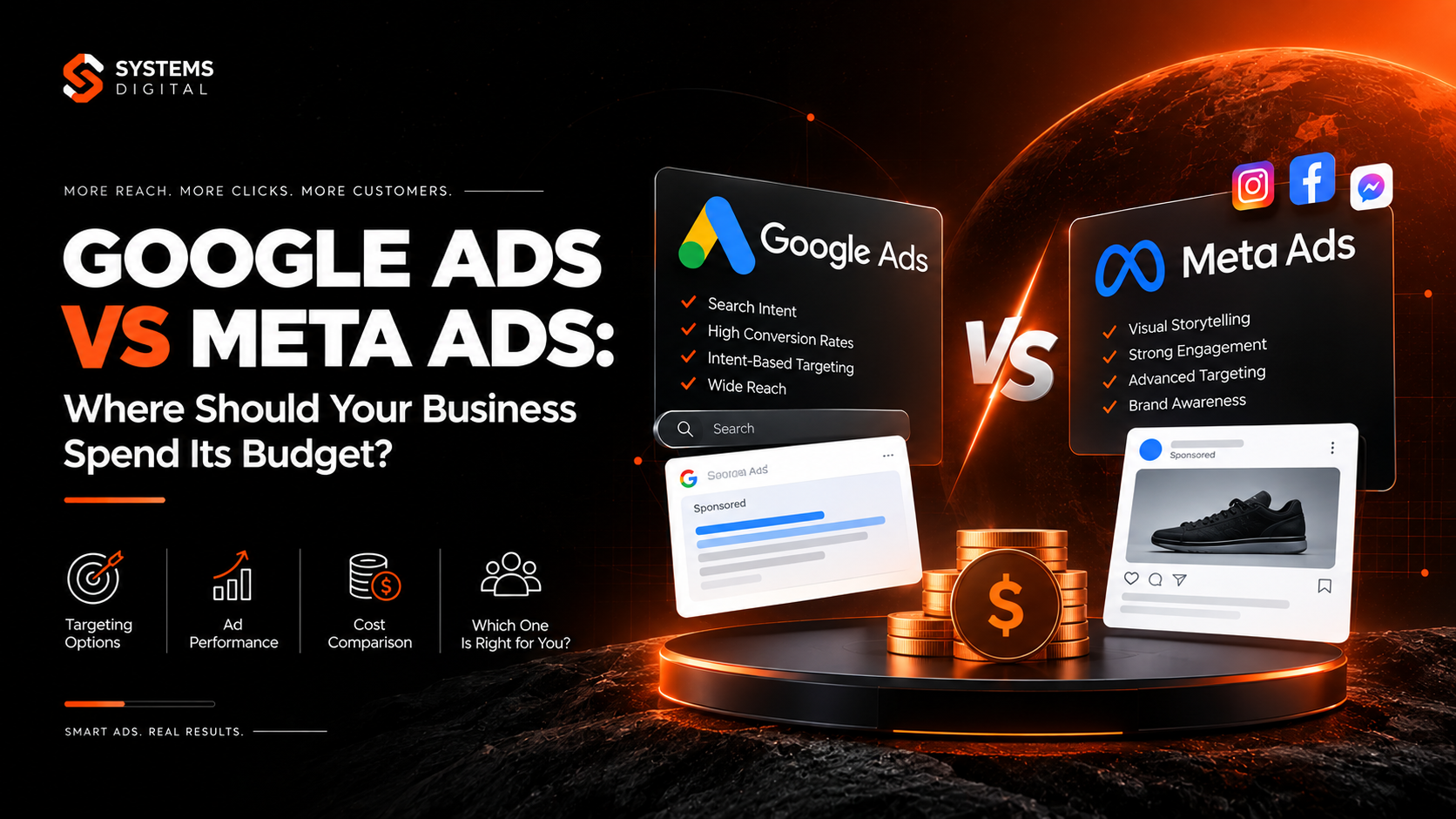
If you’ve got a limited marketing budget and you’re staring at two of the biggest advertising platforms on the planet, you’re probably asking yourself one simple question: Google Ads or Meta Ads — which one actually deserves my money?
The honest answer is: it depends on what you’re selling, who you’re selling to, and what stage of the buying journey you’re trying to reach. Google Ads captures people who are already searching for a solution. Meta Ads (Facebook and Instagram) reaches people before they even know they have a problem. Both can work brilliantly — or burn through your budget fast — depending on how you use them.
In this guide, we’ll break down the real differences between Google Ads and Meta Ads, compare costs and ROI, look at targeting and use cases, and help you figure out exactly where your business should be spending its ad dollars in 2026.
What Is Google Ads?
Google Ads is Google’s pay-per-click (PPC) advertising platform. It lets businesses show ads across Google Search, the Google Display Network, YouTube, Gmail, and Google Shopping. The defining feature of Google Ads is search intent — your ad appears when someone actively types in a query related to your product or service.
If someone searches “emergency plumber near me” or “best CRM software for small business,” Google Ads puts your business directly in front of that high-intent moment. This is why Google Ads is often described as a “demand capture” platform — it doesn’t create desire, it captures the demand that already exists.
Key Google Ads formats include:
- Search ads – text ads shown on the search results page
- Display ads – banner ads shown across millions of partner websites
- Shopping ads – product listings with images and prices, ideal for ecommerce
- YouTube ads – video ads before, during, or alongside YouTube content
- Performance Max (PMax) – an AI-driven campaign type that automatically places ads across all Google inventory based on your goals
What Is Meta Ads?
Meta Ads is the advertising platform behind Facebook, Instagram, Messenger, and the Meta Audience Network. Unlike Google Ads, Meta Ads is a demand generation platform. It doesn’t wait for someone to search — it puts your product or offer directly in front of people while they’re scrolling their feed, based on their interests, behaviors, demographics, and lookalike profiles built from your existing customers.
Meta Ads formats include:
- Feed ads – image or video ads in the Facebook/Instagram feed
- Stories and Reels ads – short, vertical, full-screen video ads
- Carousel ads – multiple images or products in one swipeable ad
- Lead ads – native forms that capture leads without leaving the app
- Retargeting ads – ads shown to people who already visited your site or engaged with your content, powered by the Meta Pixel
Because Meta Ads is built on social behavior rather than search behavior, it thrives on strong visuals, storytelling, and emotional hooks — not keywords.
Google Ads vs Meta Ads: The Core Difference
The simplest way to think about it:
- Google Ads = Intent-based advertising. You show up when someone is already looking.
- Meta Ads = Interest-based advertising. You show up when someone might be interested, even if they weren’t actively searching.
This single distinction explains almost every other difference between the two platforms — cost, targeting, creative requirements, and ideal use case.
Google Ads vs Meta Ads: Cost Comparison
Cost is usually the first question business owners ask, and it’s also the most misunderstood one, because a “cheap” click isn’t automatically a good deal if it doesn’t convert.
According to 2025 industry benchmark data, the average cost-per-click (CPC) across all industries on Google Ads Search sits around $5.26, though this varies enormously by industry — legal services and dental practices can see CPCs above $7-8, while arts, entertainment, and restaurants often pay closer to $1.60-$2 per click. # Google Ads Benchmarks: What You Need To Know +2
Meta Ads, by comparison, tends to run considerably cheaper on a per-click basis. Industry data from 2025 puts the average Facebook traffic-campaign CPC at roughly $0.70, which is significantly lower than the comparable average CPC on Google Ads. Other benchmark reports show similar patterns, with overall average Facebook CPC estimated around $1.72, and financial services facing the highest Meta CPCs near $3.77, while apparel, retail, and travel brands often pay between $0.45 and $0.70 per click. facebook ads benchmarks 2025 +4
On a cost-per-thousand-impressions (CPM) basis, the gap is just as noticeable. The average Google CPM across industries sits around $11.12, and rises to roughly $17.80 once major outlier industries are excluded. Meta CPMs vary widely depending on the data source and industry mix — some reports put the average Meta CPM around $5.97, while others tracking ecommerce-heavy accounts report a median CPM closer to $13-14, reflecting the more competitive auction environment on Meta in recent years. All articles +3
What this means practically: Meta Ads generally gets you more impressions and clicks for the same dollar, but Google Ads clicks tend to come from people closer to a buying decision. Cheap traffic isn’t automatically better traffic — it’s about matching cost to conversion value.
Google Ads vs Meta Ads: Conversion Rate and ROI
Cost per click only tells half the story. What matters more is how much of that traffic actually turns into paying customers.
Google Ads tends to post stronger conversion rates because the traffic is self-selected — people are already looking for a solution. Some benchmark data pegs the average Google Ads conversion rate around 7.52%, with certain service industries seeing conversion rates above 10%. theedigital
Meta Ads conversion rates run lower on average, generally in the 1.5%–3.4% range depending on the objective and industry, according to multiple 2025 benchmark reports. That’s not a flaw in the platform — it reflects a fundamentally different sales funnel stage. Meta is often reaching a “cold” audience that hasn’t yet decided to buy, so naturally fewer of those people convert immediately. Many of them convert later, after retargeting or after simply becoming familiar with your brand.
This is why comparing raw conversion rates between the two platforms can be misleading. A more useful comparison is return on ad spend (ROAS): Meta’s median ROAS across industries in 2025 has been benchmarked around 1.86 to 1.93, though this varies dramatically — luxury brands can see ROAS around 3.7:1 due to higher margins, while low-margin categories like dropshipping often hover closer to 2:1. triplewhaletrendtrack
Bottom line: Google Ads usually wins on conversion rate because of intent. Meta Ads usually wins on reach and cost-efficiency at scale, and can deliver excellent ROAS when your creative and targeting are dialed in — but it typically needs a bigger top-of-funnel volume to get there.
How Targeting Differs Between Google Ads and Meta Ads
This is one of the most important — and most misunderstood — differences between the two platforms.
Google Ads targeting is built around keywords and search behavior. You bid on the terms people type into the search bar, plus demographic, geographic, and device-based filters. Google also lets you layer in audience signals (like “in-market” or “affinity” audiences), but the foundation is still what someone is actively searching for right now.
Meta Ads targeting is built around identity and behavior. You can target by age, location, interests, job title, life events, purchase behavior, and — critically — by uploading your existing customer list to build lookalike audiences (new people who resemble your best customers) or retarget people who’ve already interacted with your brand using the Meta Pixel.
A simple way to remember it: Google Ads answers a question someone is already asking. Meta Ads starts a conversation with someone who didn’t know they needed the answer yet.
Google Ads vs Meta Ads: Use Cases by Business Type
Different business models genuinely perform better on one platform than the other. Here’s a practical breakdown:
Google Ads tends to work better for:
- Local service businesses (plumbers, lawyers, dentists, HVAC) where people search out of urgent need
- High-ticket B2B services where buyers actively research vendors
- Businesses with strong SEO and content already ranking, so PPC reinforces organic intent
- Ecommerce brands with a clear, well-known product category (via Google Shopping)
Meta Ads tends to work better for:
- Visually driven consumer products (fashion, beauty, home goods, food)
- Brands building awareness or launching something new that people aren’t searching for yet
- Businesses with strong video or lifestyle content
- Retargeting warm audiences who’ve visited your site but haven’t purchased
- Lead generation campaigns using native lead forms (great for coaching, real estate, courses, local events)
Should You Use Google Ads and Meta Ads Together?
For most growing businesses, the real answer isn’t “either/or” — it’s “both, working together.” A common and effective strategy looks like this:
- Meta Ads builds awareness and drives traffic to your website, content, or landing page, introducing your brand to a cold audience through engaging visuals and video.
- The Meta Pixel and Google Ads remarketing lists then let you retarget people who visited but didn’t convert.
- Google Search Ads capture the “ready to buy” moment, when that same person (now familiar with your brand) searches your business name or a related product category.
This is often called a full-funnel approach: Meta for top-of-funnel (TOFU) awareness, Google for bottom-of-funnel (BOFU) conversion. Many businesses find they get the best overall ROI by splitting budget across both platforms rather than putting everything into one.
How to Decide Your Budget Split
If you’re not sure where to start, here’s a simple framework:
- If your product solves an urgent, specific problem people actively search for (locksmith, lawyer, repair service) → lean more heavily into Google Ads.
- If your product is discretionary, visual, or new to the market (a new skincare line, a subscription box, an app) → lean more heavily into Meta Ads.
- If you’re an established ecommerce brand → run both. Google Shopping and Search catch people ready to buy; Meta drives new customer acquisition and retargeting.
- If you have a small budget (under $1,000–1,500/month) → many advertisers find it more effective to concentrate spend on one platform first, master it, then expand rather than spreading thin across both from day one.
A reasonable starting split for many small businesses testing both platforms is 50/50, then shifting budget toward whichever channel shows a lower cost-per-acquisition and higher return after 4–6 weeks of data.
Real-World Example
Consider two hypothetical businesses:
A local HVAC company relies almost entirely on Google Ads. When someone’s air conditioning breaks in July, they search “AC repair near me” that same hour — there’s no browsing or discovery phase. Meta Ads could build brand awareness, but it won’t capture that urgent, high-intent moment the way Search Ads will.
A direct-to-consumer skincare brand, on the other hand, sees most of its new customer growth from Meta Ads. Few people search “vegan retinol serum” by brand name before they’ve heard of it — but a well-targeted Instagram Reel showcasing the product’s texture and results can stop the scroll and drive a first purchase. Once that customer is retargeted and becomes familiar with the brand, Google Search Ads then capture repeat purchases and branded searches.
Neither approach is “correct” in isolation — they reflect how each platform performs at different points in the customer journey.
People Also Ask
Is Google Ads more expensive than Facebook Ads?
Generally, yes, on a cost-per-click basis. Average Facebook CPCs tend to run well below Google’s average CPC, though costs vary widely by industry on both platforms. wordstream
Which is better for lead generation, Google Ads or Facebook Ads?
Both work well, but for different reasons. Google Ads captures people already searching for a solution, while Meta’s native lead forms make it very easy for browsing users to submit their information without leaving the app — often at a lower cost per lead, though sometimes with lower lead quality since the person wasn’t actively searching.
Can I use Google Ads and Meta Ads together?
Yes, and many marketers consider this the most effective long-term strategy — using Meta for awareness and retargeting, and Google Search Ads to close the loop when interest turns into intent.
Is Meta Ads better than Google Ads for small business?
It depends on the product. Meta Ads is often more budget-friendly for visually driven products and brand-building, while Google Ads is usually stronger for local service businesses with clear, searchable demand.
Does Google Ads work better for B2B or B2C?
Google Ads tends to perform strongly for both, but especially for B2B services where decision-makers actively research vendors and solutions online before reaching out.
Is Instagram Ads part of Meta Ads?
Yes. Meta Ads Manager runs campaigns across Facebook, Instagram, Messenger, and the Meta Audience Network from a single platform.
What’s better for ecommerce: Google Shopping Ads or Facebook Ads?
Most successful ecommerce brands use both — Google Shopping Ads to capture people already comparing products, and Facebook/Instagram Ads to introduce the brand and drive impulse or discovery-based purchases.
Final Verdict: Where Should Your Business Spend Its Budget?
There’s no universal winner between Google Ads and Meta Ads — the “better” platform depends entirely on your business model, product type, and where your ideal customer is in their buying journey.
- Choose Google Ads if your customers already know what they want and are actively searching for it.
- Choose Meta Ads if your product benefits from visual storytelling and you need to create demand rather than just capture it.
- Choose both if you want a full-funnel strategy that builds awareness, nurtures interest, and captures high-intent conversions.
The businesses that get the most value from paid advertising rarely treat this as an either/or decision. They test both platforms with a modest budget, track cost-per-acquisition and ROAS closely, and shift spend toward whichever channel is actually delivering profitable customers — then keep the other platform running in a supporting role rather than cutting it entirely.