


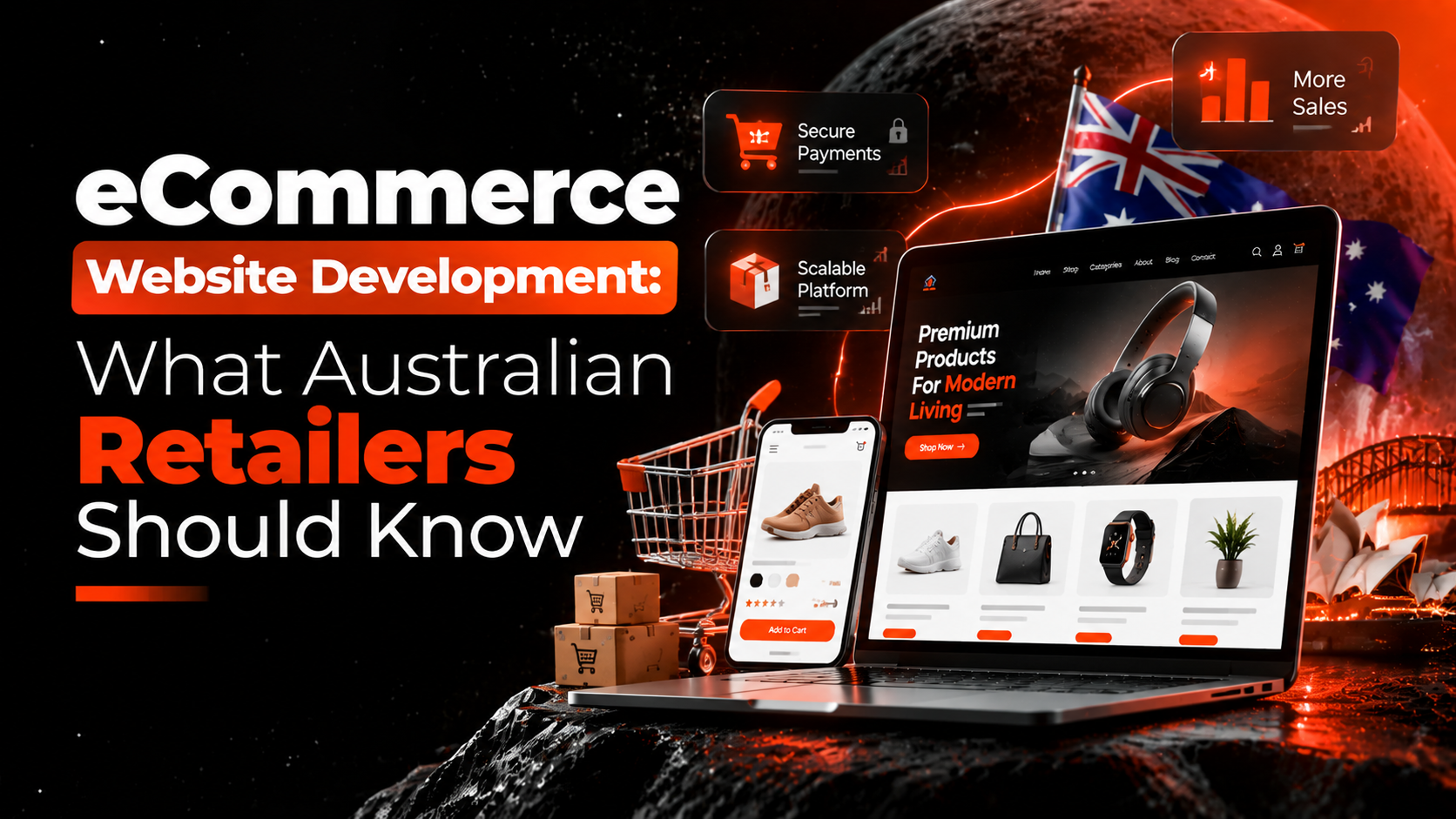
Online retail in Australia has moved well past “nice to have” territory. Australians spent $82.6 billion online in 2025, up 14% year-on-year, with online now representing 24% of total Australian retail spend and 9.8 million households shopping online. For retailers still weighing whether to invest in a proper ecommerce website — or wondering if their current one is holding them back — the numbers make the case on their own. eightx
But building an ecommerce store isn’t just about picking a platform and uploading a product catalogue. It’s a combination of design, technology, compliance, and strategy that determines whether a retailer converts browsers into buyers or loses them at checkout. This guide breaks down everything Australian retailers need to know about ecommerce website development — from platforms and costs to compliance and future trends.
What Is eCommerce Website Development?
Ecommerce website development is the process of building an online store that allows customers to browse products, add them to a cart, pay securely, and receive their order — all without human intervention on the retailer’s side. It covers everything from front-end design (what customers see) to back-end systems (inventory, payments, shipping, and data).
A well-built ecommerce website typically includes:
- A product catalogue with search and filtering
- A shopping cart and secure checkout
- Payment gateway integration
- Inventory and order management
- Shipping and fulfilment integrations
- Customer accounts and order history
- SEO-friendly architecture and fast load times
This is different from general web development, which might produce a brochure-style website with no transactional functionality. Ecommerce development is built around one goal: turning visitors into paying customers, repeatedly and reliably.
Why It Matters for Australian Retailers
The shift to online shopping in Australia isn’t a short-term trend — it’s structural. Online retail reached about 12.7% of total Australian retail turnover in June 2025 on ABS figures, up from 11.6% a year earlier and roughly double what it was in 2019. Some private estimates put the figure even higher. eightxeightx
A few reasons this matters for retailers specifically:
Customers now expect it. A retailer without a functional, mobile-friendly online store is invisible to a growing share of shoppers who research and buy on their phones.
Competition is platform-driven. Australia has roughly 153,000 live Shopify stores alone, making it one of Shopify’s strongest English-speaking markets — which means whatever category a retailer sells in, competitors are already online and optimising. eightx
Growth is uneven by state, so retailers with a national customer base can capture demand a physical footprint alone can’t reach — Western Australia grew online spend 18% in 2025, ahead of the east-coast states. eightx
Shopping frequency, not basket size, is driving growth. The average online basket actually fell slightly to $96 AUD, with growth coming from more frequent orders across more retailers — the average household now shops with 16 different online retailers a year. That means retention, repeat purchase experience, and site usability matter as much as acquisition. eightx
Key Features Every Australian eCommerce Website Needs
Not every store needs every feature, but these are the non-negotiables for a competitive Australian ecommerce website in 2026:
- Mobile-first responsive design — the majority of Australian browsing and a large share of purchasing now happens on mobile devices.
- Fast page load speed — slow sites lose sales before checkout even begins; speed also affects Google rankings.
- Local payment methods — AUD pricing by default, plus Australian-preferred options like Afterpay, Zip, PayPal, and card payments via providers such as Stripe or eWAY.
- Clear shipping and returns information — Australian shoppers expect upfront delivery timeframes and simple return policies, especially given the country’s geography.
- Secure checkout (SSL, PCI DSS compliance) — non-negotiable for handling payment data.
- Inventory sync — especially for retailers who also sell in-store or on marketplaces like Amazon Australia, Catch, or eBay.
- SEO-friendly structure — clean URLs, structured data, and fast-indexing product pages.
- Accessibility — increasingly expected, and important for both compliance and reach.
Choosing the Right Platform
The platform decision shapes everything downstream — cost, flexibility, and how quickly the store can grow. Here’s how the major options compare for Australian retailers.
Shopify
The most widely used platform in Australia by a clear margin. Shopify leads WooCommerce by roughly 1.9 to 1 in the Australian market, with around 3,600 Australian stores on Shopify Plus for larger enterprise-level retailers. Shopify suits retailers who want a fast setup, strong app ecosystem, and reliable hosting without managing infrastructure themselves. eightx
WooCommerce
A WordPress plugin rather than a standalone platform, WooCommerce appeals to retailers who already run WordPress or want more control over hosting and customisation. It’s generally cheaper to start with but requires more technical maintenance over time.
Magento (Adobe Commerce)
Built for complex, high-volume stores with heavy customisation needs — think large catalogues, B2B pricing tiers, or multi-store setups. It’s powerful but requires developer resources to run well, making it a better fit for established retailers than startups.
BigCommerce
A strong middle ground between Shopify’s simplicity and Magento’s flexibility, with solid built-in features for multi-channel selling.
Headless Commerce
For retailers wanting a fully custom front-end experience decoupled from the back-end platform, headless commerce is increasingly common — particularly for brands prioritising site speed and unique design over off-the-shelf templates.
Quick comparison:
| Platform | Best for | Technical effort | Typical cost range |
|---|---|---|---|
| Shopify | Fast-moving retailers, DTC brands | Low–medium | $$ |
| WooCommerce | WordPress users, budget-conscious stores | Medium | $ |
| Magento/Adobe Commerce | Large, complex catalogues | High | $$$$ |
| BigCommerce | Growing multi-channel retailers | Medium | –$ |
| Headless (custom) | Brand-led, performance-critical stores | High | $$$$ |
The eCommerce Website Development Process
A well-run ecommerce build generally follows these stages:
- Discovery and planning — defining goals, target customers, product range, and required integrations.
- Platform selection — matching business needs (catalogue size, growth plans, budget) to the right platform.
- UX/UI design — wireframes and visual design focused on conversion, not just aesthetics.
- Development — building the store, integrating payment gateways, shipping, and third-party tools.
- Content and product population — product descriptions, images, pricing, and SEO metadata.
- Testing — checkout flow, payment processing, mobile responsiveness, and load testing.
- Launch — DNS migration, monitoring, and post-launch support.
- Ongoing optimisation — analytics review, A/B testing, and iterative improvements.
Timelines vary widely: a simple Shopify store might launch in 4–6 weeks, while a custom Magento or headless build can take 3–6 months.
How Much Does eCommerce Website Development Cost in Australia?
Costs depend heavily on platform, complexity, and whether the build is templated or custom. As a general guide:
- Basic templated store (Shopify/WooCommerce, standard theme): $3,000–$10,000
- Mid-range custom store (custom design, integrations, moderate catalogue): $10,000–$40,000
- Enterprise/custom build (Magento, headless commerce, complex integrations): $50,000+
Ongoing costs also matter: platform fees, hosting (where applicable), app subscriptions, payment processing fees, and maintenance/support retainers. Retailers should budget for these recurring costs, not just the initial build.
Compliance Every Australian Retailer Must Get Right
This is where a lot of DIY or overseas-built stores fall short — and where working with a developer who understands the Australian market pays off.
GST registration. The GST registration threshold in Australia is $75,000 AUD of turnover on a 12-month rolling basis. Once a retailer crosses that threshold, GST must be charged, collected, and remitted correctly — which has direct implications for how pricing and checkout are configured on the website. avask
Australian Consumer Law (ACL). Online stores must clearly display pricing (inclusive of GST where applicable), accurate product descriptions, and fair returns/refund policies. Misleading claims or hidden fees can create legal exposure.
Payment security (PCI DSS). Any store handling card payments needs to meet PCI DSS compliance standards — most modern platforms and payment gateways handle much of this automatically, but it’s worth confirming rather than assuming.
Privacy Act obligations. Customer data collected through the site (accounts, order history, marketing opt-ins) needs to be handled in line with Australian privacy law, particularly for larger retailers.
Payment Gateways and Shipping for Australian Retailers
Local payment expectations matter more than many retailers realise. Popular options in Australia include:
- Card processing: Stripe, eWAY, Braintree
- Buy now, pay later: Afterpay, Zip
- Digital wallets: PayPal, Apple Pay, Google Pay
On the logistics side, integrating with Australia Post and courier partners (Sendle, StarTrack, Australia-wide carriers) for real-time shipping quotes and tracking is increasingly expected rather than optional — Australian shoppers are used to fast, transparent delivery timelines despite the country’s geographic spread.
SEO, UX and Conversion Optimisation
A beautifully designed store that no one finds, or that loses customers at checkout, isn’t doing its job. A few areas worth prioritising:
- Site speed — every second of load time delay measurably reduces conversion rates.
- Checkout simplification — guest checkout options, minimal form fields, and visible security badges reduce cart abandonment.
- Structured product data — helps products appear in Google Shopping and rich search results.
- Clear category and search navigation — especially important as catalogues grow.
- Local SEO signals — location pages, AUD pricing, and Australia-specific content help both rankings and trust.
Real-World Scenarios
A boutique fashion retailer moving from Instagram-only sales to a Shopify store typically sees the biggest early wins from mobile checkout speed and Afterpay integration, since younger shoppers expect both.
A homewares retailer with a large SKU catalogue benefits more from strong filtering, inventory sync across warehouse and retail locations, and structured data for Google Shopping visibility.
A B2B supplier expanding into direct-to-consumer sales often needs tiered pricing logic and account-based ordering — features that push the platform decision toward Magento, BigCommerce, or a custom build rather than a basic Shopify theme.
The Future of eCommerce for Australian Retailers
A few trends worth watching heading further into 2026:
- AI-assisted shopping experiences — product recommendations, chat-based search, and personalisation are becoming standard rather than premium features.
- Continued growth outside metro areas — regional and non-eastern-seaboard growth (particularly in WA and Queensland) suggests demand isn’t just concentrated in Sydney and Melbourne.
- Consolidation around fewer, stronger platforms — Shopify’s dominance in the Australian market is likely to continue as smaller platforms lose ground.
- Margin discipline over growth-at-all-costs — with input costs having risen faster than consumer spending power in recent years, retailers are prioritising conversion efficiency and retention over pure traffic growth.
Why Choose System Digital
Building an ecommerce website that performs in the Australian market takes more than platform knowledge — it takes an understanding of local compliance, payment behaviour, and what actually converts Australian shoppers. That’s where a dedicated partner makes the difference between a store that just exists and one that grows the business. If you’re planning a new build or a redesign, it’s worth reading more on Why Choose System Digital before committing to a developer.
FAQs
What is ecommerce website development?
It’s the process of building an online store — design, platform setup, payment and shipping integrations, and testing — so customers can browse and buy products without manual intervention.
How much does it cost to build an ecommerce website in Australia?
Costs typically range from $3,000 for a basic templated store to $50,000+ for a custom or enterprise-level build, depending on complexity.
Which platform is best for ecommerce in Australia — Shopify, WooCommerce, or Magento?
Shopify suits most small-to-mid retailers for its ease of use and app ecosystem. WooCommerce fits budget-conscious, WordPress-based stores. Magento is best for large, complex catalogues needing heavy customisation.
Do Australian ecommerce sites need to charge GST?
Yes, once annual turnover reaches $75,000 AUD, businesses must register for GST and charge it on applicable sales.
How can I reduce cart abandonment on my online store?
Simplify checkout, offer guest checkout, show shipping costs early, and include trusted local payment options like Afterpay or Zip.
What’s the best ecommerce platform for a small business in Australia?
For most small retailers, Shopify or WooCommerce offer the best balance of cost, ease of use, and growth flexibility.
Conclusion
Australian retailers aren’t just competing for attention anymore — they’re competing on speed, trust, and checkout experience in a market where online spending keeps climbing year over year. The right platform, correct compliance setup, and a store genuinely built for Australian shoppers are what separate the retailers growing online from the ones losing ground to it.
If you’re ready to build or upgrade an ecommerce website that’s actually built for the Australian market, explore Advanced Services at System Digital and book a seat to get started.