

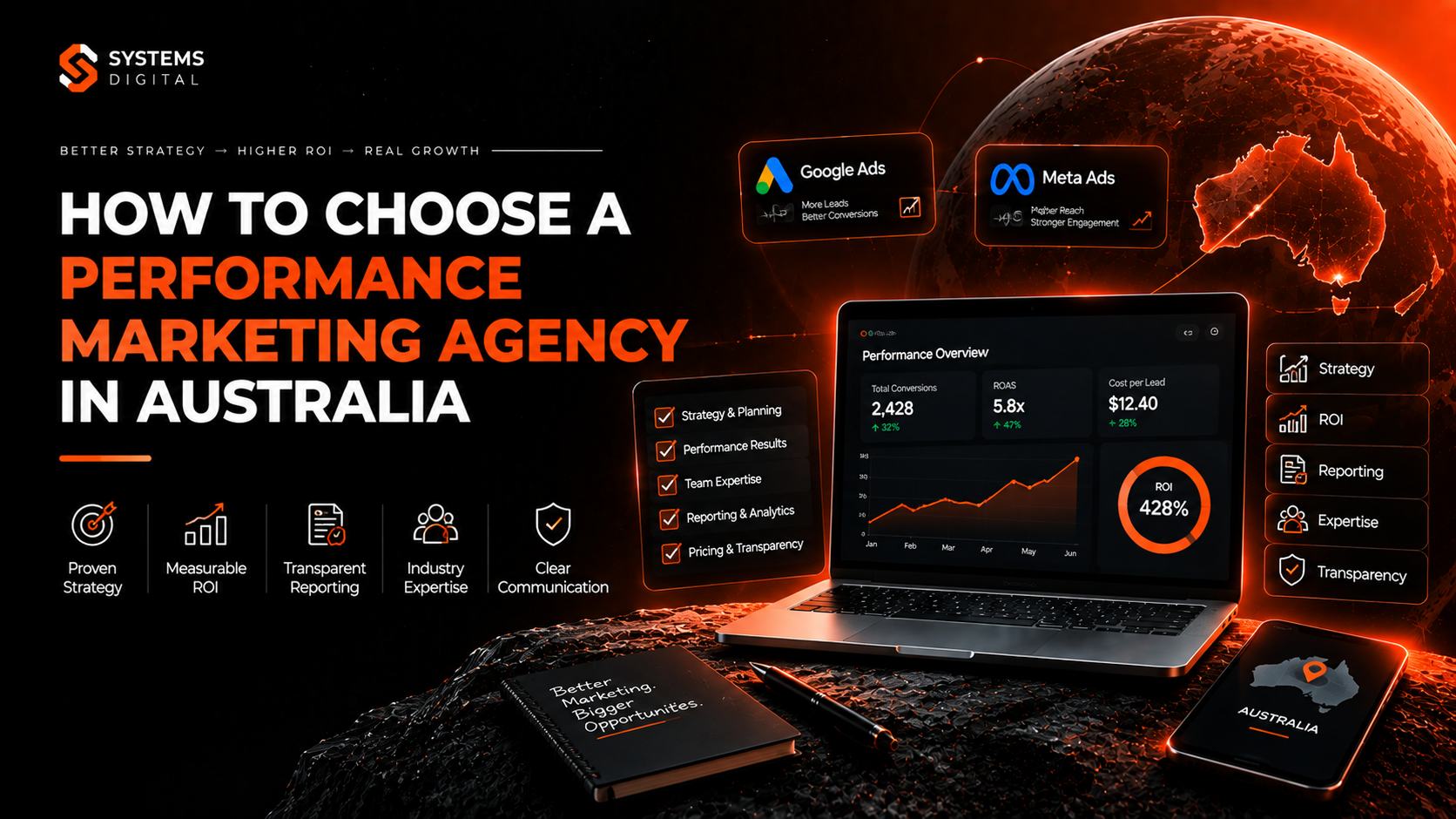
Choosing the right performance marketing agency can make or break your growth trajectory. In Australia’s crowded digital marketing landscape, dozens of agencies claim to be “data-driven,” “results-focused,” or “the best performance marketing agency in Australia” — but the reality behind those claims varies enormously. This guide breaks down exactly what a performance marketing agency does, why it matters, and how to evaluate one before you sign a contract, so you can make a decision based on evidence rather than a polished pitch deck.
What Is a Performance Marketing Agency?
A performance marketing agency is a digital marketing partner that ties its strategy — and often its fees — directly to measurable outcomes: leads, sales, sign-ups, or return on ad spend (ROAS), rather than vague brand impressions.
Unlike a traditional marketing agency, which might focus heavily on brand campaigns, creative awards, or long-term positioning, a performance marketing agency lives and dies by numbers. Core performance marketing channels typically include:
- Paid search (Google Ads, Bing Ads)
- Paid social (Meta Ads, TikTok Ads, LinkedIn Ads)
- Programmatic and display advertising
- Conversion rate optimisation (CRO)
- SEO with a performance lens (organic traffic tied to revenue, not just rankings)
- Email and lifecycle marketing
- Affiliate and partnership marketing
The unifying idea across all of these is accountability. A genuine performance marketing agency in Australia should be able to show you, in plain numbers, what a dollar spent through them returns.
Why Choosing the Right Agency Matters
Marketing budgets in Australia are under more scrutiny than ever. Rising ad costs on Meta and Google, tighter privacy rules (like the phase-out of third-party cookies), and increasingly sophisticated customers mean that businesses can no longer afford to “spray and pray.” The wrong agency doesn’t just waste money — it can actively damage your brand’s search visibility, ad account health, and customer trust through poor targeting or inconsistent messaging.
The right partner, by contrast, compounds your growth. A good performance marketing agency reduces customer acquisition cost (CAC) over time, improves ROAS, and builds systems — audiences, creative libraries, testing frameworks — that keep working even as ad platforms change.
Performance Marketing vs. Traditional (Brand) Marketing
These two disciplines are often framed as opposites, but the strongest Australian brands treat them as complementary:
| Performance Marketing | Brand Marketing | |
|---|---|---|
| Primary goal | Direct response (sales, leads, sign-ups) | Awareness, perception, long-term equity |
| Measurement | ROAS, CAC, conversion rate | Reach, sentiment, recall |
| Timeframe | Short-to-medium term | Long term |
| Budget flexibility | Highly flexible, tested weekly | Fixed campaign cycles |
If an agency tells you brand marketing and performance marketing “don’t need to talk to each other,” that’s a warning sign. The best results usually come from brand awareness feeding the top of the funnel while performance marketing captures and converts that demand efficiently.
The Performance Marketing Agency Checklist
Before you sign anything, run every shortlisted agency through this checklist.
1. Proven, Relevant Case Studies
Ask for case studies specific to your industry or a comparable one — ecommerce, B2B SaaS, healthcare, retail. Generic “we grew revenue 300%” claims without context (starting budget, timeframe, market conditions) are not useful. Ask what changed and why.
2. Transparent Reporting
A trustworthy performance marketing agency gives you real-time or weekly access to dashboards — not a static PDF once a month. You should be able to see spend, ROAS, CAC, and conversion data whenever you want it, not just when it’s flattering.
3. Clear Pricing Model
Performance marketing agencies in Australia typically charge in one of a few ways:
- Flat monthly retainer — predictable, common for small-to-mid budgets
- Percentage of ad spend — usually 10–20%, scales with your budget
- Performance-based/commission fees — tied to results, less common but growing
- Hybrid — a smaller retainer plus a performance bonus
None of these is inherently better — the right structure depends on your budget size and risk appetite. Be wary of agencies that won’t clearly explain how they get paid.
4. Team Structure and Senior Access
Ask who will actually run your account day-to-day. Many agencies sell you a senior strategist in the pitch and hand you off to a junior account manager after signing. Ask directly: will I have access to senior strategists, or only account managers?
5. Platform Certifications and Partnerships
Google Premier Partner status, Meta Business Partner status, and similar accreditations aren’t everything, but they indicate a baseline of platform expertise and often unlock early access to new ad features and better platform support.
6. Testing and Creative Process
Ask how many ad variations they test per month, how they decide what to scale versus kill, and how quickly they iterate on underperforming creative. A performance marketing agency without a structured testing cadence is just running ads, not optimising them.
7. Full-Funnel Thinking
The strongest agencies don’t stop at the click. They care about landing page conversion, checkout friction, email follow-up, and retention — because a “successful” ad that sends traffic to a broken landing page is still a failure.
Questions to Ask Before Signing a Contract
Bring these questions to every discovery call:
- What KPIs will you report on, and how often?
- Can I see a real (anonymised) client dashboard?
- What’s your average client tenure, and why do clients leave?
- Who specifically will manage my account?
- What’s your minimum contract length, and what’s the exit process?
- How do you handle underperformance — is there a review trigger?
- Do you own my ad accounts, or do I retain ownership?
- What tools and tech stack do you use for tracking and attribution?
That last point matters more than most businesses realise. If an agency builds campaigns inside accounts they own, switching agencies later can mean losing months — or years — of learning data.
How Much Does a Performance Marketing Agency Cost in Australia?
Costs vary widely depending on scope, ad spend, and agency tier. As a general guide:
- Small businesses / startups: smaller retainers, often paired with a percentage-of-spend model once budgets grow
- Mid-market businesses: retainers scale with the complexity of channels managed (search + social + CRO, for example)
- Enterprise / large ecommerce brands: custom pricing, often with dedicated teams and hybrid performance incentives
Rather than chasing the cheapest quote, compare pricing against scope: what channels are included, how many creative assets per month, and what reporting cadence you’re getting for that fee.
Red Flags to Watch For
- Vague or unverifiable results (“we 10x’d their revenue” with no context)
- Locked-in long contracts with no early exit clause
- No willingness to share a sample report or dashboard
- Guarantees of specific results (“we guarantee #1 rankings” or “guaranteed ROAS”) — no ethical agency can promise this, since platform algorithms and market conditions are outside anyone’s full control
- Reluctance to explain their testing or optimisation process
- Ownership of your ad accounts, pixels, or domains without a clear handover clause
Location Considerations: Sydney, Melbourne, Brisbane, and Perth
Australia’s performance marketing scene is concentrated but increasingly remote-friendly.
- Sydney has the largest concentration of performance marketing agencies and PPC specialists, often serving national and APAC-wide clients.
- Melbourne has built a strong reputation in ecommerce and D2C performance marketing, with a competitive market of agencies focused on data-led, no-frills growth.
- Brisbane and Perth have smaller but growing agency scenes, often more accessible for local SMBs wanting closer, in-person relationships.
Location matters less than it used to — most performance marketing work is delivered remotely — but if in-person strategy sessions matter to you, factor city presence into your shortlist.
Industries That Benefit Most From Performance Marketing
While almost any business with a measurable conversion goal can use performance marketing, it tends to deliver the strongest ROI for:
- Ecommerce and D2C brands
- SaaS and B2B lead generation
- Healthcare and allied health providers
- Property and real estate
- Education and training providers
- Retail and hospitality (local and national)
How Long Before You See Results?
This is one of the most common — and most misunderstood — questions businesses ask. Paid search and paid social can show early signals (click-through rates, cost-per-click trends) within the first 1–2 weeks, but meaningful, statistically reliable performance data — the kind you can confidently scale a budget on — usually takes 60–90 days. SEO-driven performance marketing takes longer still, often 4–6 months for organic gains to compound. Be sceptical of any agency promising dramatic results within the first few weeks.
The Future of Performance Marketing in Australia
A few shifts are already reshaping the industry heading into 2026 and beyond:
- AI-driven media buying — platforms like Google’s Performance Max and Meta’s Advantage+ are automating more targeting and bidding decisions, shifting agency value toward creative strategy and data interpretation rather than manual bid management.
- Privacy-first measurement — as third-party cookies phase out, agencies are leaning more on first-party data, server-side tracking, and modelled conversions.
- Generative Engine Optimisation (GEO) — as more consumers research through AI tools and AI-generated search summaries, agencies are starting to optimise content and structured data not just for Google rankings but for visibility inside AI-generated answers.
- Full-funnel accountability — clients increasingly expect agencies to be judged not on clicks or impressions, but on actual revenue and customer lifetime value.
Agencies that adapt to these shifts — rather than relying on channel tactics that worked five years ago — are the ones worth partnering with long-term.
Frequently Asked Questions
What does a performance marketing agency do?
A performance marketing agency plans, runs, and optimises paid and organic campaigns — such as Google Ads, Meta Ads, SEO, and CRO — with the explicit goal of driving measurable outcomes like sales, leads, or ROAS, rather than just brand awareness.
How much does a performance marketing agency cost in Australia?
Costs vary by scope and ad spend, typically structured as a flat retainer, a percentage of ad spend (often 10–20%), or a hybrid model. Get a clear scope-to-price breakdown before comparing quotes.
What’s the difference between a performance marketing agency and a digital marketing agency?
“Digital marketing agency” is a broader term covering everything from branding to web design. A performance marketing agency specifically focuses on channels and tactics that produce trackable, revenue-linked results.
Do performance marketing agencies guarantee results?
No ethical agency guarantees specific outcomes like rankings or ROAS, since ad platforms, competition, and market conditions change constantly. Be cautious of any agency that does.
Is performance marketing worth it for small businesses?
Yes, when scoped correctly. Small businesses often benefit most from a focused channel mix (e.g., just Google Ads and CRO) rather than a full-funnel package they can’t yet afford to properly test.
What KPIs should a performance marketing agency report on?
At minimum: ROAS, CAC, conversion rate, cost per lead/acquisition, and spend pacing against budget — reported on a consistent, agreed schedule.
Conclusion
Choosing a performance marketing agency in Australia comes down to evidence, not promises: transparent reporting, relevant case studies, a clear pricing model, and a team that treats your ad spend like it’s their own money. Run every shortlisted agency through the checklist above, ask the hard questions early, and prioritise partners who are upfront about what results actually take time to build.
If you’re ready to move from research to action, book a seat with our Advance Services team to get a tailored performance marketing audit and see exactly where your current strategy is leaving money on the table.