

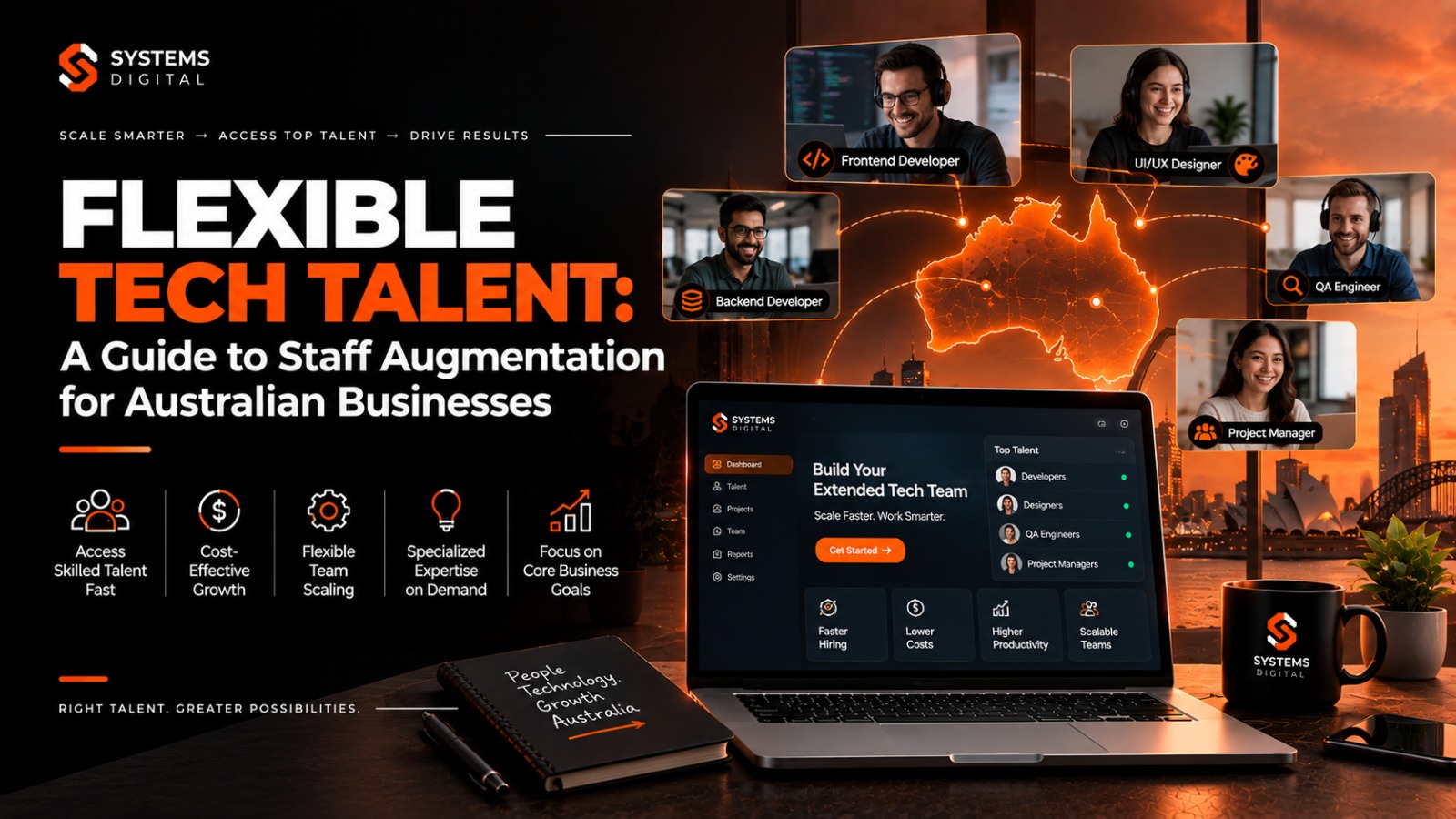
Hiring great technology people in Australia is harder than it should be. Permanent searches drag on for months, project deadlines don’t move, and the skills you need today may not be the ones you need next year.
That is why more businesses are turning to staff augmentation: adding skilled developers, engineers and specialists to your team, for as long as you need them, without the weight of a full recruitment drive.
This guide explains how staff augmentation works, what it costs, when it makes sense, and how to choose the right partner. It also covers the career side of the model. Whether you lead a startup in Brisbane or an enterprise team in Sydney, you’ll find practical steps you can use straight away.
What Is Staff Augmentation?
A simple definition
Staff augmentation is a flexible outsourcing model where you add external technology professionals to your existing team. They work under your direction, follow your processes and join your daily stand-ups. The provider handles sourcing, vetting and often payroll and compliance.
Think of it as extending your team rather than handing a project to someone else. You keep control of the work. The provider gives you fast access to talent.
How IT staff augmentation works
Most engagements follow the same path:
- Define the need. You outline the role, skills, seniority, duration and tools.
- Match talent. The provider shortlists vetted professionals from its talent pool.
- Interview and select. You meet candidates and choose the ones who fit.
- Onboard. The new team members get access to your systems, codebase and communication channels.
- Deliver and adjust. You direct the work, and you scale the team up or down as priorities change.
Common staff augmentation models
- Onshore: talent based in Australia, in your time zone and under Australian law.
- Nearshore: talent in nearby regions with similar working hours.
- Offshore: talent in distant countries, often with strong cost benefits and a wider skills pool.
- Hybrid: a mix, such as a local lead with offshore developers.
Staff augmentation vs other hiring options
| Option | Who manages the work? | Best for | Main trade-off |
|---|---|---|---|
| Staff augmentation | You | Filling skills gaps, scaling fast | Needs your management time |
| IT outsourcing | The vendor | Handing off a whole project | Less day-to-day control |
| Managed services | The provider | Ongoing operations and support | Less flexibility on scope |
| Dedicated development team | Shared | Long-term product work | Higher commitment |
| Recruitment agency | You (after hire) | Permanent hires | Slower, with placement fees |
| Freelancers | You | Small, one-off tasks | Variable quality and availability |
The main difference is control. With staff augmentation, you stay in the driver’s seat. With outsourcing or managed services, the vendor owns delivery.
Why Staff Augmentation Matters for Australian Businesses
The tech skills shortage is real
Australia’s demand for technology workers has outpaced supply for years. Early research from the Tech Council of Australia found that tech vacancy rates were 60 per cent higher than the national average, with the most severe shortages in roles such as software programmers and network professionals. HRD America
The picture has become more complicated since. The Australian Computer Society (ACS) has warned that Australia will need around 1.3 million technology workers by 2030 based on current business demand. Its latest Digital Pulse report found that the technology workforce shrank for the first time in 2025, to around 967,000 workers. Meanwhile, official figures showed Australia was not on track to meet the federal goal of 1.2 million tech-related jobs by 2030. ‘Not on track’: Australia will need 1.3 million tech workers by 2030 – report | HRD Australia +2
For a hiring manager, this means a smaller pool of experienced people and more competition for every one of them.
Speed is a competitive advantage
A permanent hire can take three months or more once you count advertising, interviews, notice periods and onboarding. Staff augmentation providers already have vetted talent ready to go. Many businesses fill roles in a few weeks instead.
That speed matters when you face:
- A product launch with a fixed date
- A cloud migration that can’t wait
- A security uplift after an audit
- A sudden spike in workload
Flexibility protects your budget
Technology work is rarely steady. You may need eight engineers for six months, then three. Permanent headcount doesn’t flex that way. Staff augmentation lets you match your team size to your actual project pipeline.
Access to specialised skills
Some skills are needed for a short time but at a high level. Think of a machine learning engineer for a proof of concept, or a DevOps specialist for a pipeline rebuild. Hiring permanently for these roles rarely makes sense. Augmentation gives you the expertise without the long-term commitment.
Key Skills, Tools and Benefits
Skills Australian businesses ask for most
Demand tends to cluster around these areas:
- Software development: frontend, backend and full stack (React, Node.js, Java, Python, .NET)
- Mobile development: iOS, Android and cross-platform apps
- Cloud and DevOps: AWS, Azure, Google Cloud, CI/CD, infrastructure as code
- Data and AI: data engineers, data scientists, machine learning engineers
- Cybersecurity: security analysts, penetration testers, compliance specialists
- Quality assurance: manual and automation testers
- Delivery roles: business analysts, project managers, UI/UX designers
Tools that make augmented teams work
A remote or blended team only performs well with the right setup. Most successful engagements use:
- Communication: Slack or Microsoft Teams, plus video calls
- Project management: Jira, Azure DevOps, Trello or Asana
- Code collaboration: GitHub, GitLab or Bitbucket with clear branching rules
- Documentation: Confluence, Notion or shared wikis
- Security: single sign-on, multi-factor authentication and role-based access
The main benefits of IT staff augmentation
- Faster hiring. You start delivering in weeks, not months.
- Lower recruitment costs. You avoid advertising, agency placement fees and long searches.
- Reduced overhead. No long-term employment costs for short-term needs.
- Scalability. You add or reduce capacity as workloads change.
- Specialist access. You bring in niche skills only when you need them.
- Retained control. Your team directs the work and protects your culture and standards.
- Lower risk. If a role doesn’t work out, you adjust quickly.
The risks to plan for
Being honest about downsides builds trust, so here are the common ones:
- Onboarding gaps. Augmented staff need context. A poor introduction slows everyone down.
- Knowledge leaving with contractors. Good documentation and handover practices are essential.
- Communication friction. Time zones and unclear expectations can cause delays.
- Management effort. You still need someone to lead the work.
- Compliance. Data handling, IP ownership and contractor arrangements must be clear from the start.
Each of these is manageable with the right partner and a clear onboarding plan.
Job Scope, Salary and Demand in Australia
What roles can be filled through staff augmentation?
Almost any technology role can be augmented. Typical placements include:
- Software developers and engineers
- DevOps and cloud engineers
- Data engineers and analysts
- QA engineers and test automation specialists
- Cybersecurity professionals
- Business analysts and product owners
- Scrum masters and project managers
- UI/UX designers
- IT support and service desk staff
What do tech professionals earn in Australia?
Pay varies by city, seniority and specialisation, and different sources report different figures. Treat the numbers below as broad guides and check current data before setting a budget.
- Salary comparison sites in 2026 place the average software engineer salary somewhere between roughly $105,000 and $130,000, with senior and specialist engineers regularly reaching $150,000 to $190,000 or more.
- For contractors, Re:Sourced reports that senior day rates in Sydney in 2026 ran from about AUD 800 to 1,100 for software roles, and from AUD 900 to 1,200 for cloud and site reliability engineering. Re:Sourced
- The same guide notes that senior cloud, platform, cyber and data day rates rose 5 to 10 per cent year over year. Re:Sourced
- Sydney generally sits at the top of the range, with Melbourne, Brisbane, Perth and Adelaide following. Perth is notable for strong contract rates.
Is staff augmentation cheaper than hiring?
Sometimes, but not always. It depends on how long you need the person.
A permanent employee costs more than their salary. Add superannuation, leave, payroll tax, equipment, training, recruitment fees and management time. A contractor or augmented specialist may have a higher headline rate, but you only pay for the time you use.
As a rule of thumb:
- Short-term or project work (under 12 months): augmentation is usually more cost-effective.
- Long-term, core product work: permanent hiring often wins on cost and continuity.
- Uncertain or changing workloads: augmentation reduces your risk.
Re:Sourced makes the same point in its 2026 guide: contracts work best for bounded engagements such as delivery spikes, cloud migrations, data platform builds and coverage while a permanent search runs. Re:Sourced
Demand outlook
Demand is strongest in cloud, cybersecurity, data and AI. Businesses in finance, retail, mining, healthcare and government all need these skills, which keeps competition high in every capital city. Even when overall hiring cools, scarce specialist skills stay in demand. That is where flexible talent models earn their place.
Why Choose System Digital
Choosing a staff augmentation partner is a trust decision. You are adding people to your team, giving them access to your systems and relying on them to deliver. Here is what to look for in a partner, and how System Digital approaches it.
What a good provider should offer
- Rigorous vetting. Technical assessments, reference checks and communication screening.
- Speed without shortcuts. A ready talent pool and a clear process.
- Transparent pricing. No hidden margins or surprise fees.
- Compliance awareness. Understanding of Australian privacy, contractor and employment rules.
- Flexibility. Easy scaling up or down.
- Ongoing support. Someone who checks in after placement.
How System Digital helps
System Digital works with Australian businesses that want dependable, flexible access to technology talent. The focus is on matching people to your project, your culture and your goals, rather than sending a stack of CVs and hoping for the best.
If you want to understand the thinking behind the service, you can read more about Why choose System Digital. You can also Explore Advanced services at System Digital to see how staff augmentation fits alongside the wider support available for your technology projects.
(Replace the “#” links with your live System Digital URLs before publishing.)
Questions to ask any provider
Use this checklist when comparing staff augmentation companies in Australia:
- How do you vet technical skills and communication?
- How quickly can you present a shortlist?
- What happens if a placement isn’t the right fit?
- Who owns the IP created during the engagement?
- How do you handle data security and privacy obligations?
- Can you support our time zone and working hours?
- What are the contract terms, notice periods and minimum commitments?
- Can we speak with a client who has used your service?
A confident provider will answer all of these clearly.
How to Learn: Free and Paid Resources
This section serves two groups: hiring leaders who want to get better at working with augmented teams, and tech professionals who want to build a career in flexible or contract work.
Free resources
- Tech Council of Australia publishes research on the local tech workforce, skills and jobs.
- ACS Digital Pulse reports track workforce trends and skills demand in Australia.
- Australian Taxation Office (ATO) guidance explains the difference between contractors and employees, which matters for compliance.
- Office of the Australian Information Commissioner (OAIC) provides guidance on the Privacy Act, relevant when external staff handle personal data.
- YouTube and community channels offer free tutorials on Agile, Scrum, Git, cloud platforms and remote collaboration.
- Free tiers and trials from AWS, Microsoft Azure and Google Cloud let you practise hands-on.
- Open-source projects on GitHub are a good way to build a public portfolio.
Paid resources
- Professional certifications: AWS, Microsoft Azure, Google Cloud, CISSP, Security+, Scrum Master (PSM or CSM) and PMP.
- Online learning platforms: structured paths from providers such as Coursera, Udemy, Pluralsight and LinkedIn Learning.
- Bootcamps and short courses: intensive programs in software development, data and cybersecurity.
- Industry events and memberships: ACS membership, local meetups and tech conferences for networking and learning.
- Advanced professional services: hands-on programs and services such as those offered through System Digital’s advanced offerings.
A simple learning plan for professionals
If you want to work in flexible tech roles, follow these steps:
- Pick a core specialisation, such as backend, cloud, data or security.
- Earn one respected certification in that area.
- Build two or three real projects and publish them.
- Practise remote collaboration tools and Agile workflows.
- Learn to communicate clearly in writing, since remote work depends on it.
- Register with reputable staff augmentation providers and keep your profile current.
A simple plan for hiring leaders
- Write clear role briefs with outcomes, not just skill lists.
- Prepare an onboarding pack: access, documentation, contacts and first tasks.
- Assign a named buddy or lead for each augmented team member.
- Set weekly check-ins during the first month.
- Capture knowledge as you go, so nothing is lost when contracts end.
Real-World Examples
The scenarios below are illustrative composites based on common patterns, not specific client case studies.
Example 1: The Melbourne retailer with a deadline
A mid-sized Melbourne retailer needed to rebuild its online checkout before the peak sales season. The in-house team was already stretched. Recruiting three permanent developers would have taken until well after the deadline.
The company brought in three augmented developers, including a frontend specialist and a QA engineer. The new members joined existing stand-ups and used the retailer’s own Jira board and repositories. The rebuild launched on time, and two of the three contracts ended cleanly once the project wrapped up.
Lesson: Augmentation works best when there’s a clear goal and a fixed window.
Example 2: The Sydney fintech scaling up
A fintech startup in Sydney raised funding and needed to double its engineering capacity within a quarter. Instead of committing to a large permanent headcount before its product direction was certain, it augmented its team with backend engineers and a DevOps specialist.
Six months later, the startup converted its best contractors to permanent roles. The trial period reduced hiring risk on both sides.
Lesson: Augmentation can act as a low-risk path to permanent hiring.
Example 3: The Perth mining company modernising its data
A Perth-based resources company wanted to move its reporting to the cloud. It had strong operational expertise but few data engineers. A small augmented team of cloud and data specialists worked alongside internal staff, and knowledge transfer sessions were built into the plan.
By the end of the engagement, the internal team could run the platform independently.
Lesson: Build knowledge transfer into the contract from day one.
Example 4: The Brisbane government supplier needing security cover
A Brisbane software supplier needed a cybersecurity specialist to prepare for a compliance audit. The need was real but temporary. Augmentation gave the company access to certified expertise for four months, with no long-term cost.
Lesson: Specialist, short-term needs are ideal for augmentation.
Future Career Opportunities in Australia
For tech professionals, flexible work is no longer a fallback. It’s a legitimate and often rewarding career path.
Why the outlook is strong
- AI and data: Businesses across every sector are investing in AI, and many lack the in-house skills to deliver it.
- Cybersecurity: Regulation and rising threats keep demand high.
- Cloud and platform engineering: Migrations and modernisation projects continue across industries.
- Remote and hybrid work: Employers are more open to distributed teams than before, which widens the talent pool and the opportunities.
- Skills shortages: Even with some market fluctuation, scarce specialist skills remain hard to find.
Career benefits of flexible tech work
- Exposure to a variety of industries and technology stacks
- Faster skill growth through diverse projects
- Higher earning potential, especially for in-demand specialists
- Greater control over your schedule and workload
- A strong network built across many clients
Skills that will keep you in demand
- Cloud architecture and automation
- Security and compliance awareness
- Data engineering and applied AI
- Strong communication and documentation
- Agile delivery and stakeholder management
- Adaptability, meaning the ability to learn a new codebase quickly
Where the opportunities are
Sydney and Melbourne offer the deepest markets. Brisbane, Perth, Adelaide and Canberra each have strong niches, from resources and energy to defence and government. Remote-first employers increasingly hire across state lines, so your location matters less than it used to.
Frequently Asked Questions
What is staff augmentation?
Staff augmentation is a flexible hiring model where you add external technology professionals to your existing team for a set period. They work under your direction and follow your processes, while the provider handles sourcing, vetting and often administration. It helps you fill skills gaps quickly without permanent hiring.
How does IT staff augmentation work?
You tell the provider what skills you need, how long you need them and what your project involves. The provider shortlists vetted candidates, you interview and select, and the new team members are onboarded into your tools and workflows. You manage the daily work and scale the team up or down as needed.
What is the difference between staff augmentation and outsourcing?
With staff augmentation, you add people to your team and keep control of the work. With IT outsourcing, you hand a project or function to a vendor who manages delivery and is accountable for the outcome. Augmentation offers more control. Outsourcing offers more hands-off delivery.
How much does staff augmentation cost in Australia?
Costs depend on the role, seniority, location and engagement length. In 2026, senior software contractors in Sydney commonly fall in the range of about AUD 800 to 1,100 per day, with cloud, data and cybersecurity specialists often priced higher. Offshore and nearshore models can reduce costs. Always request a transparent quote that includes any provider margin.
When should a business use staff augmentation?
Use it when you need to scale quickly, fill a skills gap, meet a fixed project deadline or manage fluctuating workloads. It also suits businesses that want to test a role before making a permanent hire. It is less suitable for long-term, core roles where continuity and deep company knowledge matter most.
Is staff augmentation suitable for startups and small businesses?
Yes. Startups and small businesses often benefit most because they can access senior skills without permanent salaries or long recruitment cycles. The key is having a clear scope and someone internal to guide the work.
Conclusion
Australia’s technology talent market is competitive, and it’s unlikely to get easier soon. Staff augmentation gives businesses a practical way to respond. You get skilled people when you need them, control over how they work, and the freedom to scale as your priorities change.
To recap the essentials:
- Staff augmentation extends your team while you retain control.
- It’s fastest and most cost-effective for short-term, specialist or fluctuating needs.
- Success depends on clear briefs, good onboarding and a trustworthy partner.
- For professionals, flexible tech work offers variety, growth and strong earning potential.
If you’re ready to build a more flexible, scalable technology team, take the next step. Book a seat at Advance Services offered by System Digital and find out how the right talent and the right support can help your business deliver more, faster.