

What Is Full-Funnel Marketing?
Full-funnel marketing is a strategy that plans, runs and measures marketing across every stage of the customer journey, from awareness through consideration to conversion, so each stage supports the next.
Instead of running isolated campaigns, a full-funnel marketing approach asks one question at every step: what does this person need right now to move forward?
The marketing funnel in plain language
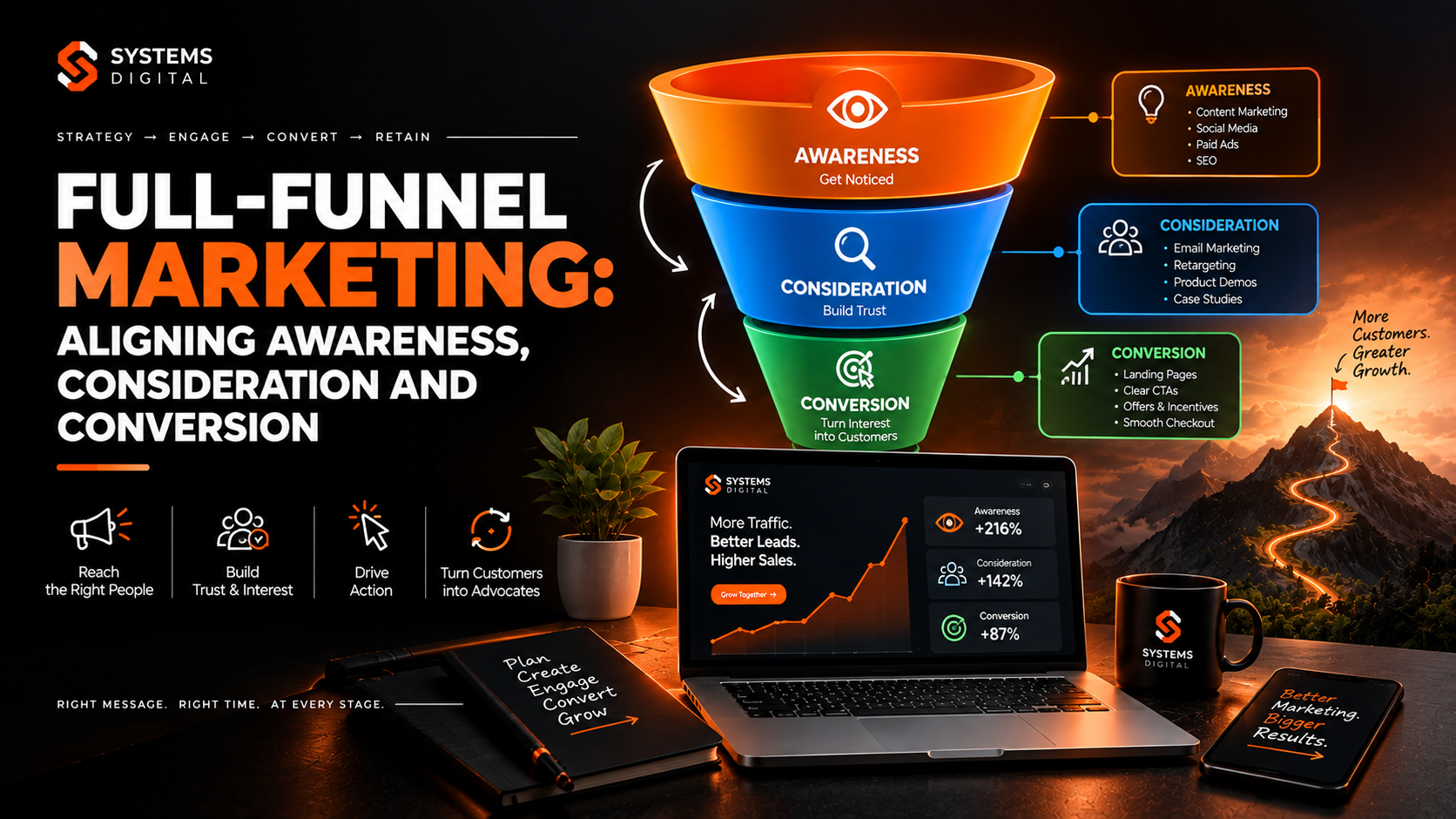
The marketing funnel is a model of how people become customers. It is wide at the top, because many people first hear about you, and narrow at the bottom, because fewer people buy. Most versions use three core stages:
- Awareness (top of funnel, or TOFU): People discover you exist.
- Consideration (middle of funnel, or MOFU): People compare you with alternatives.
- Conversion (bottom of funnel, or BOFU): People decide and take action.
Many teams add a fourth stage, retention and advocacy, because a happy customer is often your cheapest source of new customers.
Full-funnel marketing vs. performance marketing
Performance marketing focuses on measurable, short-term results such as clicks, leads and sales. Full-funnel marketing includes performance tactics but also invests in brand building and nurturing. Think of it this way: performance marketing harvests demand, while full-funnel marketing also creates it.
Marketing funnel vs. sales funnel
The marketing funnel covers how people find and evaluate you. The sales funnel usually starts once a lead is qualified and covers conversations, demos, proposals and closing. A strong sales and marketing funnel treats these as one journey with a clean handover in the middle.
Why Full-Funnel Marketing Matters
Buyers rarely move in a straight line. They read a post, forget you, see an ad weeks later, search your brand name, read reviews, and finally buy. A single-channel or single-stage plan misses most of that path.
Key benefits of a full-funnel marketing strategy
- Less wasted spend. You stop pouring budget into bottom-funnel ads when the real gap is at the top.
- A steadier pipeline. Awareness today feeds consideration next month and sales after that.
- Better customer experience. Messages match what people actually need at each moment.
- Clearer measurement. You see where prospects drop off and fix that stage first.
- Stronger marketing and sales alignment. Both teams share definitions, goals and data.
- Higher lifetime value. Retention and nurturing keep customers buying.
What happens without it
A common pattern looks like this. A business spends heavily on search ads aimed at people ready to buy. Results look good at first, then costs climb because the pool of ready buyers is limited. Nobody has built the audience that would have created new demand. Full-funnel marketing prevents this by filling the top of the funnel while you convert the bottom.
Stage 1: Awareness (Top of Funnel Marketing)
At the awareness stage, your audience may not know you or even know they have a problem. Your goal is to be seen, understood and remembered, not to sell.
Goals of TOFU marketing
- Reach the right target audience at scale
- Build brand awareness and trust
- Educate people about a problem or opportunity
- Grow your retargeting and email audiences
Best awareness stage content and channels
- SEO and blog content: Educational articles that answer common questions
- Social media marketing: Short videos, carousels and community posts
- Video marketing: Explainers and how-to content on YouTube
- Display and paid social: Reach campaigns that introduce your brand
- Influencer and partner marketing: Borrowed trust from relevant voices
- PR and podcasts: Authority-building exposure
Awareness KPIs
- Impressions and reach
- Organic traffic and new users
- Video views and watch time
- Brand search volume
- Social engagement rate
- Share of voice
Practical tip
Write for the problem, not your product. A prospect searching “why are my leads not converting” wants a diagnosis, not a sales pitch. Answer the question well, and you earn attention you can build on.
Stage 2: Consideration (Middle of Funnel Marketing)
Now the person knows you exist. They are comparing options, reading reviews and testing whether you can solve their problem. Your goal is to build trust and prove value.
Goals of MOFU marketing
- Deepen customer engagement
- Qualify leads and build buyer intent
- Handle objections before they become dealbreakers
- Move marketing qualified leads (MQLs) toward sales readiness
Best consideration stage content
- Case studies and testimonials: Proof beats promises
- Comparison pages: “Us vs. them” and “best options for…” guides
- Webinars and workshops: Live teaching builds credibility fast
- Email lead nurturing sequences: Helpful, staged follow-ups
- Product demos and free tools: Let people experience the value
- Retargeting and remarketing campaigns: Stay visible to people who already visited
- Lead magnets: Templates, checklists and guides in exchange for contact details
Consideration KPIs
- Email open and click-through rates
- Return visits and pages per session
- Content downloads and webinar sign-ups
- Cost per lead (CPL)
- MQL volume and quality
- Engagement with comparison or pricing pages
Practical tip
Map objections to content. If prospects keep asking “is this worth the price?”, publish a return-on-investment breakdown. If they worry about setup, publish an onboarding walkthrough.
Stage 3: Conversion (Bottom of Funnel Marketing)
At this stage, the person is ready to act. Your job is to remove friction and make the decision feel safe and easy.
Goals of BOFU marketing
- Turn leads into customers
- Increase conversion rates on key pages
- Shorten the sales cycle
- Support sales with the right proof at the right time
Best conversion stage tactics
- High-converting landing pages with one clear message and one primary call to action
- CTA optimization: Specific, benefit-led button text and placement testing
- Free trials, consultations and demos
- Checkout optimization for ecommerce: fewer fields, clear shipping costs, guest checkout
- Retargeting for conversions: Reminders, offers and social proof for people who almost bought
- Sales enablement: Case studies, one-pagers and objection-handling scripts
- Live chat and quick follow-up for high-intent visitors
Conversion KPIs
- Conversion rate
- Cost per acquisition (CPA)
- Customer acquisition cost (CAC)
- Return on ad spend (ROAS)
- Lead-to-customer rate
- Revenue and pipeline value
Practical tip
Speed matters. Responding to a hot lead within minutes rather than days often makes the difference between a sale and a lost opportunity. Automate the first response, then have a human follow up.
How to Align Awareness, Consideration and Conversion
Knowing the stages is easy. Connecting them is where most strategies fail. Here is a step-by-step process you can follow.
Step 1: Map your customer journey
Interview customers, review sales calls and study analytics. Document the questions people ask, the channels they use and the moments they hesitate. This is your customer journey map, and it is the foundation of everything else.
Step 2: Build audience segments and personas
Not every visitor is the same. Segment by industry, company size, need, behaviour or location. Create buyer personas or an ideal customer profile (ICP) so your messaging speaks to real people.
Step 3: Assign one clear job to each stage
- Awareness: earn attention
- Consideration: earn trust
- Conversion: earn action
When every campaign has one job, it is easier to design and measure.
Step 4: Map content to stages
Create a content map with topic, format, channel, stage and call to action. Every piece should lead to a logical next step. A TOFU blog post should link to a MOFU guide. A MOFU guide should point to a demo or consultation.
Step 5: Connect your channels
An omnichannel approach keeps the message consistent across search, social, email, video and your website. Someone who sees your ad and then visits your site should feel they are in the same conversation.
Step 6: Use retargeting to bridge the gaps
Retargeting and remarketing reconnect with people who already engaged. Segment them by behaviour. A blog reader gets a guide. A pricing-page visitor gets a case study. A cart abandoner gets a reminder.
Step 7: Align marketing and sales
Agree on what counts as an MQL and a sales qualified lead (SQL). Set service-level expectations for follow-up. Share feedback both ways so marketing learns which leads actually close.
Step 8: Measure the whole journey
Track KPIs for each stage, then look at the full picture with multi-touch attribution. Last-click reporting alone gives all the credit to the final touch and undervalues the awareness and nurture work that made it possible.
Step 9: Test and optimise continuously
Find the biggest drop-off between stages and fix that first. Run A/B tests on headlines, offers, forms and emails. Small improvements at each stage compound.
Full-Funnel Marketing Metrics and KPIs
A simple way to organise measurement is one primary metric per stage, backed by a few supporting metrics.
| Stage | Primary metric | Supporting metrics |
|---|---|---|
| Awareness | Reach / new users | Impressions, brand search, video views |
| Consideration | Qualified leads (MQLs) | CPL, email engagement, return visits |
| Conversion | Conversion rate | CPA, CAC, ROAS, revenue |
| Retention | Customer lifetime value | Repeat purchase rate, churn, referrals |
Watch the drop-off rates
The funnel drop-off rate tells you where people leave. If many visitors read your content but few join your list, your consideration offers need work. If many leads enter but few buy, look at sales handover, pricing clarity or lead quality.
Budget allocation
There is no universal split, because it depends on your industry, sales cycle and brand maturity. A common starting point for brands that need growth is to invest meaningfully in awareness and consideration alongside conversion, then adjust based on data. Treat any ratio you read online as a hypothesis to test, not a rule.
Full-Funnel Marketing for Different Business Types
B2B marketing funnel
B2B buyers involve several decision-makers and take longer to decide. Focus on thought leadership, LinkedIn, webinars, case studies, account-based marketing (ABM) and strong sales enablement. Nurture matters more here than almost anywhere.
B2C marketing funnel
B2C journeys are often shorter and more emotional. Lean on social proof, video, influencers, promotions and fast checkout. Retention tactics such as loyalty programs and email flows keep revenue growing.
Ecommerce marketing funnel
- Awareness: Social video, influencers, SEO for category terms
- Consideration: Reviews, comparison guides, email welcome flows
- Conversion: Abandoned cart emails, dynamic retargeting, streamlined checkout
- Retention: Post-purchase emails, subscriptions, loyalty rewards
Small businesses
You do not need a giant budget. Start with one channel per stage, such as SEO content for awareness, email for consideration and a well-tuned landing page for conversion. Add channels as results justify it.
SaaS companies
Free trials, product-led content, webinars and onboarding emails carry much of the funnel. Measure trial-to-paid conversion and activation, not just sign-ups.
Channels That Support a Full-Funnel Strategy
- SEO: Captures demand at every stage, from “what is” queries to “best” and “pricing” searches
- Content marketing: Educates, builds authority and feeds every other channel
- Paid search (PPC): Strong for high-intent bottom-funnel queries, and useful for mid-funnel comparison terms
- Paid social: Excellent for reach and retargeting
- Email marketing: The workhorse of lead nurturing and retention
- Video marketing: Builds trust and explains complex offers quickly
- Marketing automation and CRM: Connect behaviour to timely, personalised messages
How AI is changing the funnel
AI now supports audience segmentation, predictive lead scoring, content personalisation, ad optimisation and reporting. Used well, it helps teams send more relevant messages faster. Used carelessly, it produces generic content and poor targeting. Human strategy, brand voice and quality control still matter.
Key Skills, Tools and Benefits of Learning Full-Funnel Marketing
Skills employers look for
- Customer research and audience segmentation
- SEO and content strategy
- Paid media (Google Ads, Meta Ads, LinkedIn Ads)
- Email and marketing automation
- Conversion rate optimization (CRO) and landing page testing
- Analytics, attribution and reporting
- Copywriting and messaging
- CRM knowledge and sales alignment
- Clear communication and commercial thinking
Common tools
- Analytics: Google Analytics 4, Looker Studio
- SEO: Semrush, Ahrefs, Google Search Console
- Ads: Google Ads, Meta Ads Manager, LinkedIn Campaign Manager
- Email and automation: HubSpot, Mailchimp, Klaviyo, ActiveCampaign
- CRM: HubSpot, Salesforce, Zoho
- Testing and UX: Hotjar, Microsoft Clarity, Google Optimize alternatives such as VWO
Benefits of mastering the full funnel
- You become a strategist, not just a channel specialist
- You can prove marketing’s impact on revenue
- You are more valuable across agencies, in-house teams and consulting
- You can adapt as platforms change, because the logic of the journey stays the same
Job Scope, Salary and Demand in Australia
Businesses across Australia are investing in digital channels and want people who can connect the dots between them. Full-funnel thinking is valuable in roles such as:
- Digital marketing specialist or executive
- Performance marketing manager
- SEO or content strategist
- Paid media specialist
- CRO specialist
- Marketing automation or CRM specialist
- Growth marketer
- Demand generation manager
- Digital marketing manager or head of marketing
Salary expectations
Pay varies widely by city, industry, experience and whether you work in an agency, in-house or freelance. Entry-level digital marketing roles generally sit at the lower end of professional salary ranges, while experienced managers and specialists in paid media, analytics or marketing automation can earn considerably more. For current figures, check live sources such as SEEK salary guides, Glassdoor and the Australian Government’s Job Outlook tool, since ranges shift with the market.
Demand
Demand tends to be strongest for people who combine strategy with hands-on skills such as analytics, automation and paid media. Sydney, Melbourne and Brisbane have the largest number of agency and in-house roles, while Perth and Adelaide have growing digital economies. Remote and hybrid work has also opened opportunities beyond the major hubs.
Why Choose System Digital
If you want to learn full-funnel marketing with practical, job-focused training, the provider you pick matters. Here is what to look for, and where Why choose System Digital fits in.
- Industry-relevant curriculum: Training built around real campaigns, tools and workflows
- Hands-on learning: Projects that mirror actual client work
- Experienced trainers: Guidance from practitioners who know the market
- Career support: Portfolio building, interview preparation and pathways into work
- Up-to-date content: Coverage of AI tools, analytics and platform changes
When you compare courses, ask about project work, trainer experience, class size, assessment style and graduate outcomes.
How to Learn Full-Funnel Marketing (Free and Paid)
Free resources
- Google Skillshop: Free training and certification for Google Ads and Analytics
- HubSpot Academy: Free courses on inbound marketing, content and email
- Meta Blueprint: Free training for Meta advertising
- YouTube and podcasts: Practical tutorials and case breakdowns
- Industry blogs: Regular reading to stay current
- Your own project: Launch a small site or newsletter and run a simple funnel yourself
Paid options
- Instructor-led courses and bootcamps: Structured learning with feedback
- Professional certifications: Useful signals for employers
- Mentorship and workshops: Personal guidance on your own campaigns
A simple learning roadmap
- Learn the funnel model and customer journey basics
- Study SEO and content marketing for awareness
- Learn email, lead nurturing and retargeting for consideration
- Practise landing pages, CRO and paid ads for conversion
- Master analytics, attribution and reporting
- Build a portfolio with a real or simulated full-funnel campaign
If you want structured guidance, explore Advanced services at System Digital for training that goes beyond the basics.
Real-World Full-Funnel Marketing Examples
These are illustrative scenarios that show how the stages connect. They are not tied to specific named brands or results.
Example 1: Local ecommerce store
Awareness: Short social videos show the product in use, backed by SEO articles on buying guides.
Consideration: A welcome email series shares reviews, a comparison chart and a size guide.
Conversion: Abandoned cart emails and retargeting ads offer free shipping for a limited time.
Retention: A post-purchase sequence suggests related products and invites reviews.
Example 2: B2B software company
Awareness: LinkedIn thought leadership and a research-based blog series.
Consideration: A webinar, a comparison page and a customer case study.
Conversion: A free demo, a tailored proposal and a sales follow-up within the same day.
Retention: Onboarding emails, a customer community and quarterly check-ins.
Example 3: Professional services firm
Awareness: Local SEO and a helpful “how to choose” guide.
Consideration: Client testimonials, an FAQ page and a free checklist.
Conversion: A simple booking page for a free consultation.
Retention: A newsletter and referral incentives.
Common mistakes to avoid
- Focusing only on bottom-funnel ads
- Creating great content with no next step
- Using the same message for every stage
- Ignoring existing customers
- Relying only on last-click attribution
- Letting marketing and sales use different definitions of a good lead
Future Career Opportunities in Australia
The direction of the industry favours people who can see the whole journey.
- Data and attribution: As privacy rules tighten and third-party cookies decline, first-party data and smarter measurement are growing skill areas.
- AI-assisted marketing: Professionals who can guide AI tools with strategy and judgement will stand out.
- Marketing automation and CRM: Personalised journeys at scale need skilled builders.
- Growth and revenue marketing: Companies increasingly want marketers accountable for pipeline and revenue, not just traffic.
- Leadership paths: Full-funnel experience is a strong route to marketing manager, head of growth or CMO roles.
- Freelancing and consulting: Small and mid-sized businesses often need part-time strategists who can build and manage an entire funnel.
If you are starting out, build a small portfolio that shows one complete journey: a piece of awareness content, a nurture email sequence, a landing page and a simple report. That single project speaks louder than a list of tool names.
Frequently Asked Questions
What is full-funnel marketing?
Full-funnel marketing is a strategy that plans and measures marketing across every stage of the customer journey: awareness, consideration and conversion. Each stage has its own goal, content and metrics, and all stages are connected so prospects move smoothly toward a purchase.
What are the three stages of a marketing funnel?
The three core stages are awareness, consideration and conversion. Awareness introduces your brand, consideration builds trust and compares options, and conversion turns interested prospects into customers. Many teams add retention as a fourth stage.
How do you create a full-funnel marketing strategy?
Map your customer journey, define audience segments, set a clear goal for each stage, create content that matches each stage, connect your channels, and track KPIs across the whole funnel. Then test and improve the stage with the biggest drop-off first.
What is the difference between full-funnel marketing and performance marketing?
Performance marketing focuses on measurable short-term actions like clicks and sales. Full-funnel marketing includes performance tactics but also builds awareness and nurtures leads, creating demand as well as capturing it.
Which metrics matter most in full-funnel marketing?
Track reach and new users at awareness, qualified leads and engagement at consideration, and conversion rate, CPA, CAC and ROAS at conversion. Add customer lifetime value and retention rate to understand long-term impact.
Is full-funnel marketing worth it for small businesses?
Yes. Small businesses can start simple with one channel per stage, such as SEO content, email nurturing and a strong landing page. This avoids wasting budget on conversion ads alone and builds a steady flow of customers.
Conclusion: Take the Next Step
Full-funnel marketing is not about doing more. It is about connecting what you already do so every effort supports the next. Awareness creates interest, consideration builds trust, and conversion turns that trust into action. Measure each stage, fix the biggest leak, and repeat.
If you are ready to build these skills or lead a stronger marketing strategy in Australia, take the next step today. Book a seat at Advance Services offered by System Digital and learn how to plan, run and measure a complete full-funnel strategy with expert guidance.