

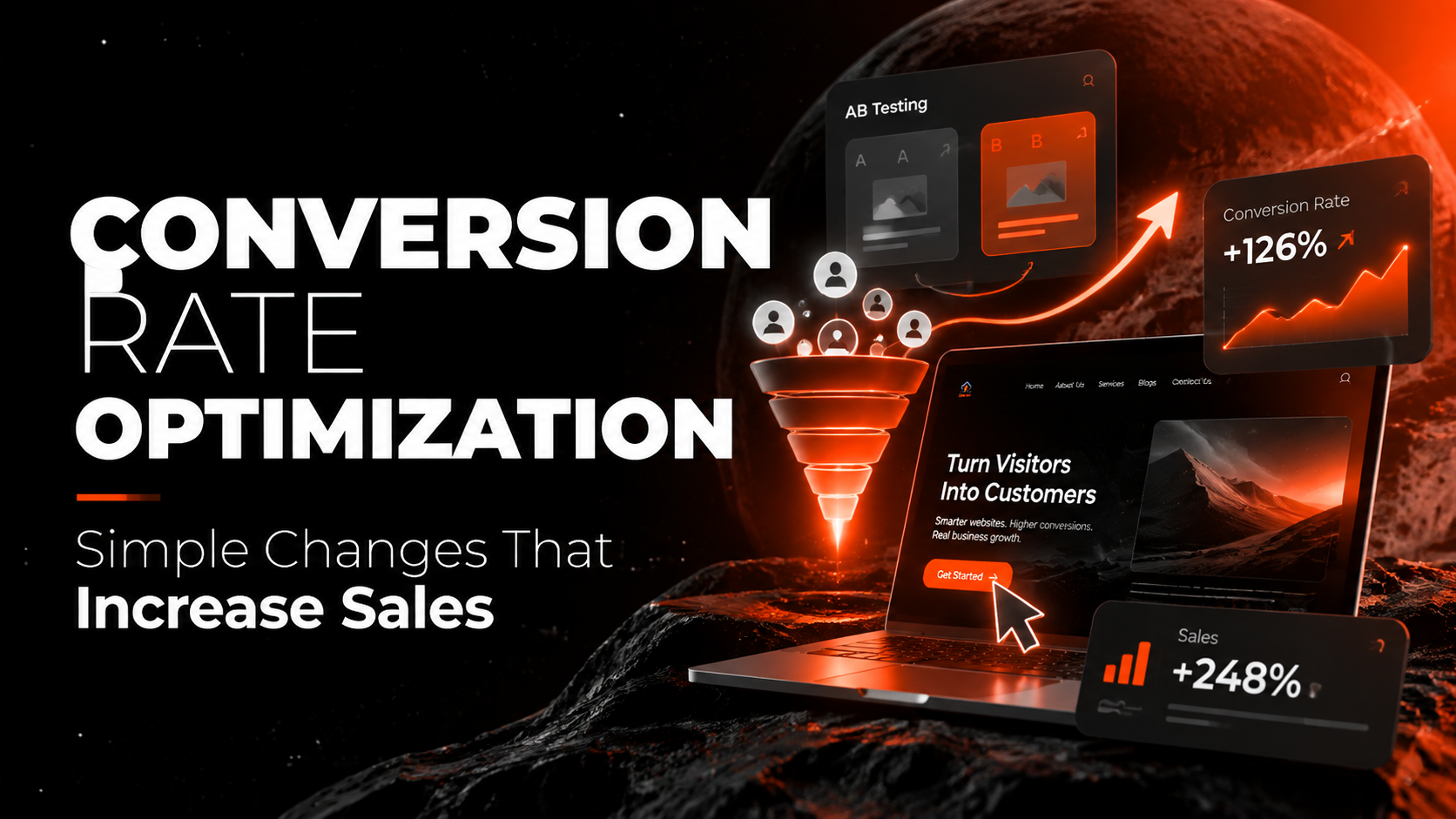
If you’re driving traffic to your website but not seeing the sales to match, you don’t necessarily have a traffic problem — you have a conversion problem. Conversion rate optimization (CRO) is the practice of turning more of your existing visitors into customers, without spending another dollar on ads. The best part? Many of the highest-impact changes are simple, fast to implement, and don’t require a website rebuild. In this guide, we’ll break down what CRO actually is, why it matters more than ever in 2026, and the specific, practical changes you can make this week to start converting more browsers into buyers.
What Is Conversion Rate Optimization?
Conversion rate optimization is the systematic process of increasing the percentage of website visitors who complete a desired action — whether that’s making a purchase, filling out a form, signing up for a newsletter, or booking a consultation. Your conversion rate is calculated with a simple formula:
Conversion Rate = (Number of Conversions ÷ Total Visitors) × 100
So if 1,000 people visit your site and 25 of them buy something, your conversion rate is 2.5%. CRO is about improving that number through research, testing, and iterative changes — not guesswork.
Unlike SEO, which focuses on getting more people to your site, CRO focuses on what happens once they arrive. That’s why the two work best together: SEO conversion strategies bring in the right visitors, and CRO makes sure those visitors don’t leave empty-handed.
Why CRO Is Important for Your Business
Most businesses pour their budget into acquisition — SEO, paid ads, social media — while their website quietly leaks potential customers at every stage. Here’s why that’s a costly mistake:
- It’s cheaper than acquiring new traffic. Improving your conversion rate from 2% to 3% is often far less expensive than trying to increase traffic by 50% to get the same result.
- It compounds across every channel. A better-converting website makes every traffic source — SEO, paid search, social, email — more profitable.
- It exposes friction you didn’t know existed. CRO forces you to look at your site through your customer’s eyes, uncovering issues like confusing navigation, slow load times, or unclear pricing.
- Small gains add up. A 0.5% conversion rate improvement on a site doing $50,000/month in revenue can mean tens of thousands of dollars in additional annual sales.
What Is a Good Conversion Rate?
This is one of the most common questions in CRO, and the honest answer is: it depends on your industry, traffic source, and device mix. That said, current benchmark data gives us a useful range.
Multiple industry sources report the global average ecommerce conversion rate at around 2.5% as of Q3 2025, up 0.4 percentage points year over year, though figures vary by data source and methodology. As a general guide: ringly
- Below 2% — below average, likely room for improvement
- 2–3% — solid, average performance
- 3.2%+ — top 20% of ecommerce stores immerss
- 4.7%+ — top 10% of ecommerce stores immerss
Conversion rates also vary dramatically by industry — food and beverage sites convert as high as 6%+, while luxury goods often sit under 1.5%. Device matters too: desktop conversion rates tend to outperform mobile significantly, even though mobile drives the majority of retail traffic. Rather than chasing a generic industry average, compare your site against your own historical performance and your closest competitors. ringlyringly
Key CRO Skills, Tools & Benefits
Essential CRO Tools
Getting started with conversion rate optimization doesn’t require an enormous budget. Common tools include:
- Heatmap and session recording tools (e.g., Hotjar, Microsoft Clarity) — see where users click, scroll, and drop off
- A/B testing platforms (e.g., Google Optimize alternatives, VWO, Optimizely) — test variations of pages against each other
- Analytics platforms (Google Analytics 4, Shopify Analytics) — track conversion funnels and drop-off points
- On-site survey tools — ask visitors directly why they didn’t convert
- Page speed testers (Google PageSpeed Insights, GTmetrix) — diagnose load-time issues
Skills Needed for Effective CRO
A strong CRO practitioner blends several disciplines: data analysis, basic UX/UI principles, persuasive copywriting, an understanding of buyer psychology, and comfort running structured A/B tests. You don’t need to master all of these overnight — even applying one or two consistently can shift your numbers.
Benefits of CRO
Beyond the obvious sales lift, CRO improves user experience, reduces customer acquisition costs, increases average order value, and builds a website that gets more valuable over time rather than staying static.
Simple Changes That Increase Sales
This is the core of the guide — the practical, high-impact changes you can start making today.
1. Optimize Your Call-to-Action (CTA)
Your CTA is the single most important element on any conversion-focused page. Small tweaks — clearer wording, higher contrast buttons, placing the CTA above the fold, or using action-driven language (“Get My Free Quote” instead of “Submit”) — can noticeably lift click-through and conversion rates. Test one CTA variable at a time so you know exactly what moved the needle.
2. Improve Page Load Speed
Page speed isn’t just an SEO ranking factor — it’s one of the highest-ROI levers in CRO. Industry data shows as little as a 0.1-second improvement in mobile load speed can lift retail conversions by roughly 8%, while a 1-second delay can cost around 7% of conversions. Compress images, minimize redirects, use a content delivery network (CDN), and audit third-party scripts that slow your pages down. elogic
3. Build Trust with Social Proof
Reviews, testimonials, trust badges, and “as seen in” logos reduce the hesitation that stops visitors from completing a purchase. Placing real customer reviews near your CTA or on product pages is one of the fastest ways to increase confidence and reduce bounce rate.
4. Simplify the Checkout Process
Cart abandonment remains a massive issue — the average documented cart abandonment rate sits around 70%, and unexpected costs at checkout are the single biggest reason, responsible for roughly half of all abandonment. Reduce checkout steps, offer guest checkout, show total costs (including shipping) early, and display multiple payment options. blendcommerceelogic
5. Prioritize Mobile Optimization
With mobile traffic dominating most retail sites, a clunky mobile experience directly suppresses conversions — mobile conversion rates lag well behind desktop despite carrying the majority of visits. Ensure buttons are thumb-friendly, forms are short, and text is legible without zooming. ringly
6. Run A/B and Split Tests
Never guess when you can test. A/B testing lets you compare two versions of a headline, image, layout, or CTA against real traffic to see which one actually performs better — removing opinion from the equation.
7. Clarify Your Value Proposition
If a visitor can’t understand what you offer and why it matters within five seconds of landing on your page, they’ll leave. Lead with a clear, benefit-driven headline that answers “what’s in it for me?”
8. Reduce Cart Abandonment with Reminders
Combine checkout simplification with abandoned cart emails, exit-intent popups, and limited-time incentives to recover sales that would otherwise be lost.
9. Use Heatmaps and Customer Journey Mapping
Watch real user behavior through heatmaps and session recordings to find exactly where visitors hesitate, scroll past important content, or abandon a form.
10. Optimize Landing Pages for a Single Goal
High-converting landing pages focus on one offer and one action. Remove navigation menus, competing links, and distractions that pull attention away from the conversion goal.
CRO Career Opportunities & Demand in Australia
As more Australian businesses shift budget from pure acquisition toward maximizing the value of existing traffic, demand for CRO specialists — in agencies, in-house ecommerce teams, and freelance consultancies — continues to grow across major markets including Melbourne, Sydney, and the Gold Coast. Businesses increasingly look for conversion rate optimization services rather than treating CRO as a one-off project, which is creating steady, recurring demand for CRO analysts, UX researchers, and digital marketing optimization specialists.
Why Choose System Digital
If managing heatmaps, A/B tests, and checkout audits sounds like more than your team has time for, that’s exactly where a dedicated CRO partner earns its keep. Working with System Digital gives you a structured, data-led approach to conversion rate optimization instead of guesswork — from a full conversion rate optimization audit to ongoing testing and reporting. If you’re ready to go further, you can also [explore Advanced Services at System Digital] for a complete, done-for-you optimization program.
Real-World Examples
- An online retailer that simplified its checkout from five steps to two saw a meaningful drop in cart abandonment within weeks.
- A SaaS landing page that changed its CTA from “Submit” to “Start My Free Trial” saw a noticeable lift in sign-ups — a classic example of how small copy changes affect outcomes.
- An ecommerce store that added customer reviews directly beneath its product images saw increased add-to-cart rates almost immediately.
These aren’t isolated wins — they reflect a consistent pattern: the businesses that treat CRO as an ongoing discipline, not a one-time fix, see compounding returns.
How to Learn CRO (Free & Paid Resources)
- Free: Google Analytics Academy, Google Skillshop, CXL’s free CRO content, Baymard Institute’s public research
- Paid: CXL Institute’s CRO certification, Optimizely and VWO academies, structured agency training programs
FAQs
What is conversion rate optimization?
CRO is the process of increasing the percentage of website visitors who take a desired action, such as making a purchase, without needing more traffic.
How do you calculate conversion rate?
Divide the number of conversions by total visitors, then multiply by 100.
What is a good conversion rate for a website?
Generally, 2–3% is average for ecommerce, with 3.2%+ considered strong and 4.7%+ considered excellent, though this varies heavily by industry.
How long does it take to see CRO results?
Simple changes like CTA or page speed fixes can show results within days to weeks; structured A/B testing programs typically need several weeks per test for statistically reliable results.
What causes low conversion rates?
Common causes include slow page load speed, unclear CTAs, unexpected checkout costs, poor mobile experience, and lack of trust signals.
What’s the difference between CRO and SEO?
SEO focuses on attracting more visitors to your site; CRO focuses on converting the visitors you already have into customers.
Conclusion
You don’t need a website redesign or a bigger ad budget to increase sales — you need to make the most of the traffic you already have. Start with one or two of the changes above, measure the impact, and build from there. If you’d rather have a team handle the audits, testing, and optimization for you, book a seat with System Digital’s Advanced Services and start converting more of your traffic into revenue.