

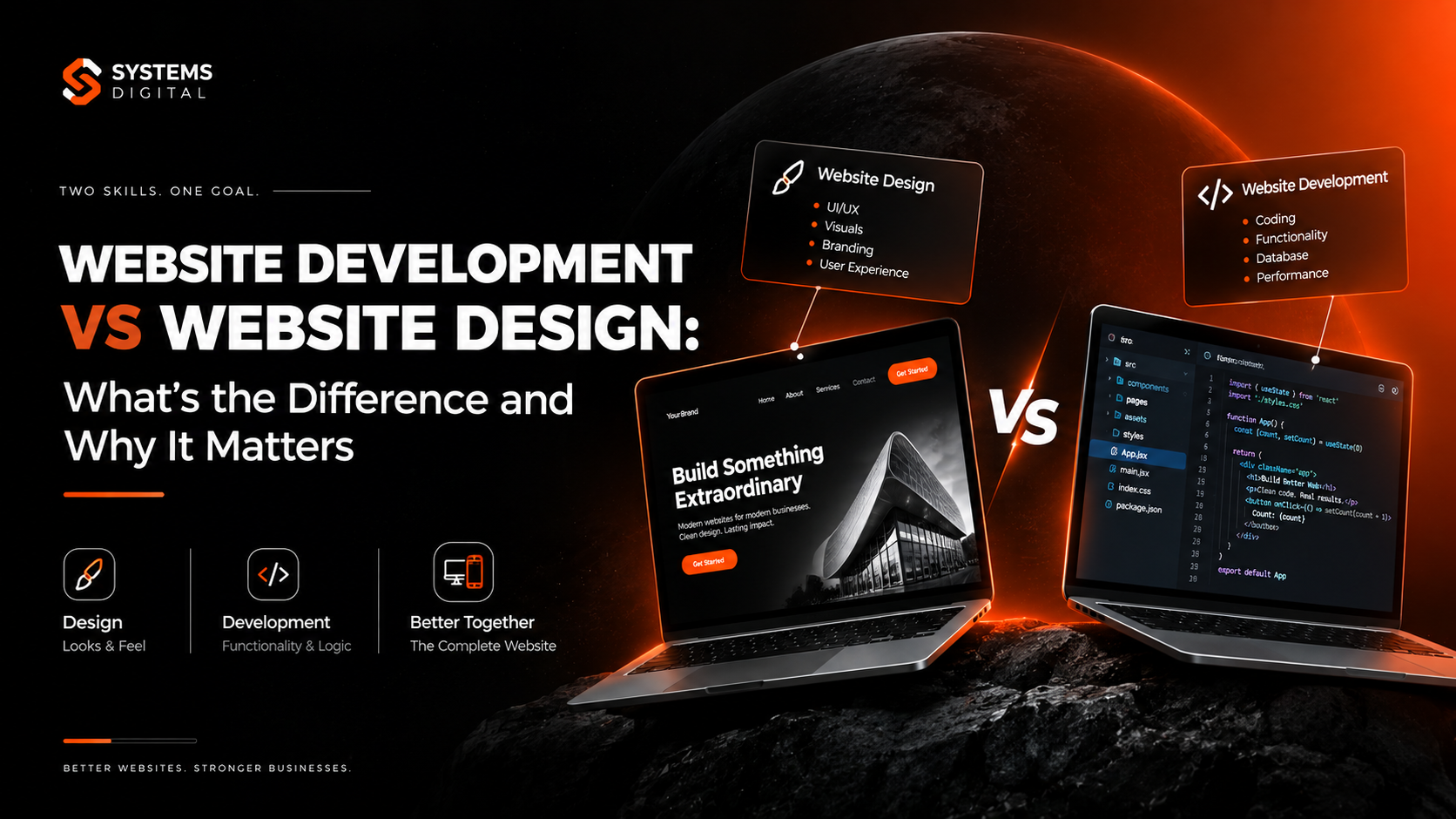
If you’ve ever hired someone to “build” you a website, you’ve probably heard both terms thrown around like they mean the same thing. They don’t. Understanding the difference between web design and web development isn’t just a technical detail — it directly affects your budget, your timeline, and the final quality of your website. In this guide, we’ll break down website development vs website design, explain how the two disciplines work together, and help you figure out exactly what your project needs. Whether you’re a business owner planning your first site or simply curious about how modern websites come together, this article will give you a clear, practical answer.
What Is Website Design?
Website design refers to the visual layout, look, and feel of a website — essentially, everything a visitor sees and interacts with on screen. A web designer focuses on how a site looks, how it’s organized, and how easy it is to use.
Website design typically includes:
- Layout and structure – arranging content, images, and navigation in a logical, visually appealing way
- Color schemes and branding – choosing colors, fonts, and imagery that reflect a business’s identity
- User interface (UI) design – designing buttons, menus, forms, and other on-page elements
- User experience (UX) design – ensuring the site is intuitive, accessible, and easy to navigate
- Website wireframes and mockups – creating blueprints of the site before development begins
In short, website design is about communication and usability. A well-designed website guides visitors naturally toward the information or action they’re looking for, without confusion or friction.
What Is Website Development?
Website development is the technical process of building the website itself — turning a design into a fully functioning site that works on the internet. This is where code, logic, and functionality come into play.
Website development is generally split into two main areas:
Front-End Development
Front-end development is the “client-side” of a website — the part that runs in a visitor’s browser. Front-end developers take a designer’s mockup and bring it to life using:
- HTML – the structural foundation of a webpage
- CSS – controls styling, layout, and responsiveness
- JavaScript – adds interactivity, animations, and dynamic behavior
A front-end developer ensures the website looks exactly like the design across different devices and screen sizes — this is what’s known as responsive web design.
Back-End Development
Back-end development is the “server-side” of a website — the part users don’t see, but that makes everything work behind the scenes. This includes:
- Servers and hosting infrastructure
- Databases that store content, user data, and transactions
- Application logic and business rules
- Content management systems (CMS) like WordPress, which allow site owners to update content easily
Developers who handle both front-end and back-end work are often called full stack developers.
Website Design vs Coding: Where’s the Line?
A common point of confusion is website design vs coding. Design is conceptual and visual — it’s created using tools like Figma, Adobe XD, or Sketch, without writing a single line of code. Development, on the other hand, is where that concept is translated into actual code that a browser can render.
Think of it like building a house: the designer draws the blueprint and chooses the finishes, while the developer lays the foundation, wires the electricity, and builds the walls according to that blueprint. You need both — a beautiful blueprint means nothing without solid construction, and solid construction without a good blueprint often results in a site that works but feels clunky or unappealing.
Web Developer vs Web Designer: Key Differences
| Aspect | Web Designer | Web Developer |
|---|---|---|
| Focus | Visual appearance, layout, UX | Functionality, code, performance |
| Tools | Figma, Adobe XD, Photoshop | HTML, CSS, JavaScript, backend frameworks |
| Output | Wireframes, mockups, style guides | Working website, functional code |
| Skills | Color theory, typography, UX principles | Programming languages, databases, logic |
| Question they answer | “How should this look and feel?” | “How does this actually work?” |
Both roles require creativity, but a designer’s creativity shows up in visuals, while a developer’s creativity shows up in problem-solving and technical execution.
Website Design Process vs Website Development Process
The Website Design Process
- Research – understanding the business, audience, and competitors
- Wireframing – sketching basic page layouts
- Visual design – applying colors, fonts, and branding
- Prototyping – building an interactive mockup for feedback
- Client review and revisions – refining the design based on feedback
The Website Development Process
- Planning architecture – deciding on the tech stack, CMS, or framework
- Front-end coding – converting the approved design into HTML, CSS, and JavaScript
- Back-end setup – building databases, server logic, and integrations
- Testing – checking functionality, speed, and responsiveness across devices
- Deployment and website hosting – launching the site live on a server
- Website maintenance – ongoing updates, security patches, and performance monitoring
Notice that design typically happens first, and development follows — though in agile workflows, both often happen in overlapping stages with constant collaboration.
Why Both Website Design and Development Matter
A site with excellent design but weak development might look stunning on your screen but load slowly, break on mobile devices, or lack essential functionality like secure checkout. On the flip side, a site with flawless code but poor design might work perfectly — but visitors will bounce because it’s confusing, outdated, or unattractive.
This is why most web design and development services bundle both disciplines together. Custom website design and development ensures the visual identity and technical execution are built in harmony from day one, rather than stitched together afterward.
Statistics back this up: research from usability experts consistently shows that users form an opinion about a website in under a second, and that first impression is dominated by visual design according to studies referenced by the Nielsen Norman Group, a leading authority on UX research. Meanwhile, page speed and functionality — both development concerns — are proven ranking and conversion factors for search engines like Google.
E-Commerce Website Development: A Special Case
E-commerce sites highlight the design-development relationship perfectly. An e-commerce website development project requires:
- Design elements: intuitive product pages, clear calls-to-action, trustworthy checkout flow
- Development elements: secure payment gateway integration, inventory databases, real-time stock updates, and performance optimization for high traffic
Without strong design, customers won’t trust the store enough to buy. Without strong development, the store won’t process payments securely or reliably. This is a clear example of why web design and development must work as a unified process rather than two disconnected tasks.
Web Development Frameworks and Tools
Modern websites are rarely built entirely from scratch. Developers commonly use frameworks and platforms such as:
- WordPress – a popular CMS for content-driven sites and blogs
- React – a JavaScript library for building fast, interactive front-ends
- Shopify – purpose-built for e-commerce development
- Webflow – blurs the line between design and development with visual, code-free building tools
These tools speed up both the design and development process, though custom coding is often still needed for advanced functionality.
Who Do You Need: A Designer, a Developer, or Both?
- Simple brochure site with basic needs? A designer using a website builder (like Wix or Squarespace) might be enough.
- Custom-branded business site? You’ll likely need both a designer for branding/UX and a developer for custom functionality.
- E-commerce, web app, or complex platform? You need a full team — designers for UX/UI and developers for both front-end and back-end work.
Most professional web design and development companies provide both services under one roof, which avoids miscommunication between separate design and development teams and ensures a consistent final product.
Why Choose System Digital
If you’re looking for a team that understands both sides of this equation, Why Choose System Digital is worth exploring. System Digital combines skilled UI/UX designers with experienced front-end and back-end developers, so your project isn’t handed off between disconnected teams — it’s built cohesively from concept to launch. For businesses that need more advanced functionality, custom integrations, or ongoing support, you can also explore advanced services at System Digital.
Whether you’re searching for a website design and development company in your city, comparing web design vs web development company options, or simply looking for affordable web design and development services, working with a team that handles both disciplines in-house typically results in a smoother process and a stronger final product.
Frequently Asked Questions
What is the difference between web design and web development?
Web design focuses on how a website looks and feels — layout, colors, and usability. Web development focuses on how a website works — the code and functionality that make it run.
Is web development harder than web design?
Neither is inherently “harder” — they require different skill sets. Development leans on logical, technical problem-solving, while design leans on visual and user-experience thinking. Many professionals find one more challenging based on their natural strengths.
Do I need both a web designer and a developer?
For most professional websites, yes. Design without development can’t function online, and development without design often results in a site that works but looks unprofessional or is hard to use.
Can a web designer also be a web developer?
Yes — some professionals, often called “UI developers” or “designer-developers,” have skills in both areas, especially with tools like Webflow that blend visual design with light coding.
What comes first, web design or web development?
Design typically comes first, since developers need a visual blueprint (wireframes and mockups) to build from. However, in agile teams, design and development often happen in parallel with ongoing collaboration.
How much does website design and development cost?
Costs vary widely based on complexity — a simple site might cost a few hundred dollars using a website builder, while a custom-coded business site or e-commerce platform can range from a few thousand to tens of thousands of dollars, depending on features and scope.
Conclusion
Understanding website development vs website design helps you make smarter decisions when planning your next website — whether that means hiring the right freelancer, choosing the right agency, or simply setting realistic expectations for your project. Design shapes how your website looks and feels; development makes sure it actually works. The best websites come from these two disciplines working together seamlessly.
If you’re ready to bring both design and development expertise together for your next project, book a seat at Advanced Services offered by System Digital and let a team that understands the full picture bring your website to life.